
10 fascinating facts about bees worth knowing
Bees are extraordinary insects that play a crucial role in our ecosystem and daily lives. They do not only produce honey but, above all, are some of the most important plant pollinators, on which the existence of many crops and ecosystems depends. Their industriousness, organisation, and fascinating skills make them deserve our attention and care. Although we may not realise on a daily basis how much we owe to these small insects, their contribution to our lives is invaluable.
Do you want to learn 10 fascinating facts about bees? We invite you to read this short post!
Table of contents:
2. One bee produces only 1/12 of a teaspoon of honey in its lifetime
3. Bees have their own 'dances'
4. Bees can fly at speeds of up to 25 km/h
5. A bee visits about 100 flowers during a single trip
6. The mother bee, or queen, can lay up to 2,000 eggs a day
8. Bee families consist of up to 60,000 bees
9. Bees 'warm up' before flight
10. Without bees, we wouldn't have one-third of our food
1. A bee can recognise faces
Bees have the ability to recognise human faces, which is incredibly surprising given their tiny brains. Research has shown that these insects can remember and distinguish faces using mechanisms similar to those used by humans. Bees do not see faces the way we do – they do not perceive them in detail, but they recognise patterns. They analyse key elements, such as eyes, nose, and mouth, and their arrangement in space. This allows them to create mental images that they later use to recognise a specific person again.
This is an amazing achievement, considering that a bee's brain is over 20,000 times smaller than a human's. Nevertheless, these insects can process visual information in an extremely advanced way. In their natural environment, the ability to recognise patterns helps bees identify flowers and navigate; however, studies have proven that these same mechanisms can be adapted to recognise human faces.
2. One bee produces only 1/12 of a teaspoon of honey in its lifetime
The fact that a single bee produces only 1/12 of a teaspoon of honey throughout its entire life perfectly illustrates the immense commitment and work behind every jar of honey we consume. Although this amount seems negligible, for a bee it is the result of weeks of intense work, during which it collects nectar from hundreds of flowers.
To produce one teaspoon of honey, the collective effort of about 12 bees is required. During its life, a worker bee must visit thousands of flowers to collect enough nectar. This nectar is then processed into honey by the entire colony, which involves a complex process of evaporating water and enriching the nectar with enzymes that break down sugars.
During a single flight, a bee visits as many as 50-100 flowers, and during its life, it can make from several hundred to even several thousand such flights. All of this is to gather honey reserves that are essential for the survival of the entire colony during difficult periods, such as winter. Each bee therefore has its small but crucial task, which, combined with the work of other bees, leads to the creation of this precious product.
3. Bees have their own 'dances'
Bees communicate with each other in an incredibly fascinating way – through dance. When a worker bee finds a rich source of nectar, pollen, or water, it returns to the hive and performs a special dance, known as the waggle dance. This is one of the most complex forms of communication in the insect world, enabling bees to precisely convey information about the location of food.
During the dance, the bee moves in a complex figure-of-eight path and makes distinct body movements. Two pieces of information conveyed by its 'waggling' are key:
Direction – the line of the dance indicates at what angle relative to the sun other bees should fly to reach the nectar.
Distance – the time the bee spends waggling informs other workers how far they must fly to reach the source. The longer the waggling lasts, the more distant the goal.
Interestingly, bees are also able to adjust their dance to changing conditions. They take into account, for example, changes in the sun's position during the day, which makes their communication system exceptionally precise.
If the food source is close to the hive (up to about 50-100 metres), bees use a simpler round dance, in which the bee circles in small rings to communicate that food is nearby.
This dance is much more than just conveying information about food – it is a key element of the hive's social organisation. Thanks to it, bees are able to cooperate effectively and optimally use available resources, which is essential for the colony's survival. The bee dance is a fascinating example of nature in full harmony, where precision and cooperation play a fundamental role.
4. Bees can fly at speeds of up to 25 km/h
Bees, although small and delicate, are amazingly skilled flyers. They can reach speeds of up to 25 km/h, which is an impressive result considering their size and mass. This speed allows them to move efficiently between flowers in search of nectar, pollen, or water, as well as to return quickly to the hive with their collected bounty.
Bee flight is extremely efficient, which is crucial given the enormous amount of work they must perform to provide food for the colony. Each bee makes dozens, or even hundreds, of trips a day, flying from flower to flower, and their flight speed allows them to make more effective use of the short time they can collect food (mainly during warm, sunny days).
However, speed is not everything. Bees are also incredibly agile in flight. Their wings move at a frequency of about 200 beats per second, which not only allows them to achieve high speeds but also to manoeuvre in the air with extraordinary precision. Thanks to this, they can easily avoid obstacles, land on small, delicate flowers, or precisely enter the hive.
Despite these impressive skills, bees do not fly at maximum speed all the time. They mainly use their fast flight when they need to return quickly to the hive with food or avoid threats. While collecting nectar, they move more slowly and carefully to thoroughly search the flowers.
5. A bee visits up to 100 flowers during a single trip
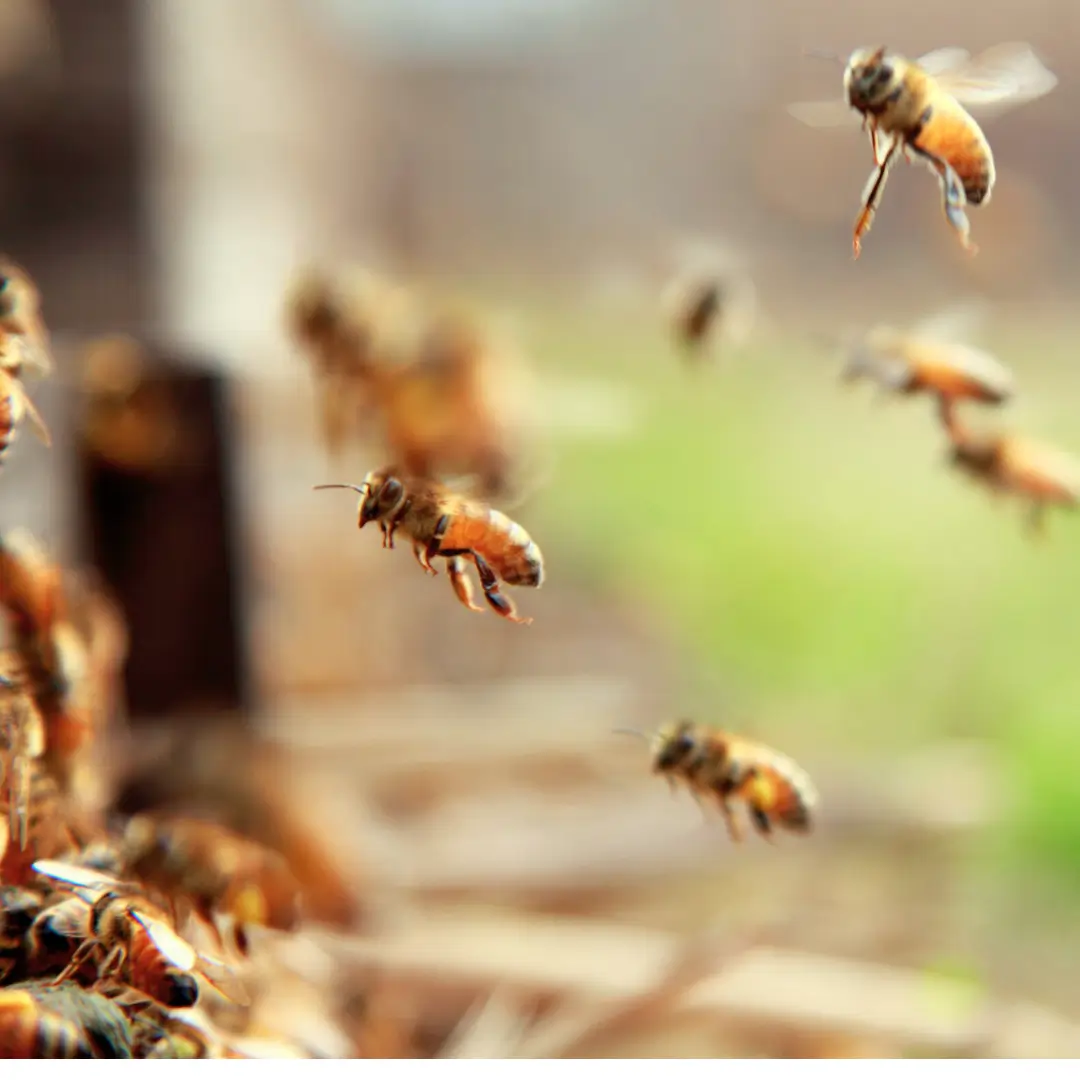
Bees are extremely efficient pollinators, and their industriousness is key to the ecosystem and agriculture. During a single trip in search of nectar and pollen, a bee can visit between 50 and 100 flowers. This number seems impressive, considering the size of these insects and the amount of energy they must put into each flight.
A single bee, by performing dozens of such trips a day, has a huge impact on plant reproduction. On a global scale, as many as 75% of crop plants that form the basis of our diet depend on pollination by insects, primarily bees.
When visiting so many flowers during one trip, bees are also very selective. They try to focus on one species of plant during a single flight, which increases pollination efficiency. This phenomenon is called floral fidelity and is extremely important for farmers, as it ensures effective pollination of specific crops.
Bees are not only industrious but also perfectly organised. Each trip in search of food is precisely planned and coordinated. Foraging workers that leave the hive set out to previously located food sources, which increases the efficiency of the entire colony.
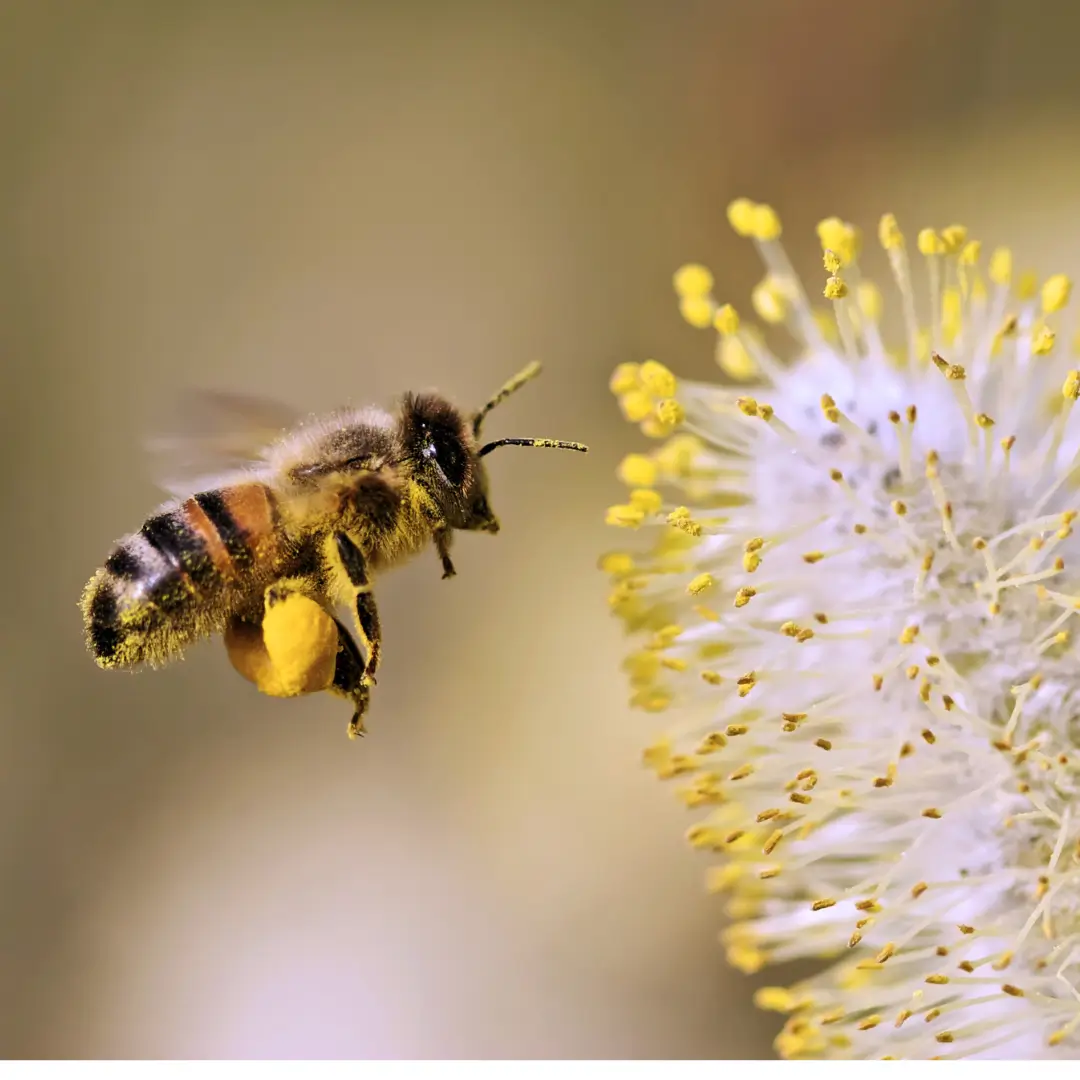
6. The mother bee, or queen, can lay up to 2,000 eggs a day
The queen bee, also known as the mother bee, is the central figure in the hive structure, whose main role is to ensure the continuity and development of the bee family. Although her function seems simple, the responsibility she carries on her shoulders is enormous. The queen is the only bee in the hive capable of laying fertilised eggs, which makes her a key element for the survival of the entire colony.
The queen's reproductive potential is impressive – in a single day, she can lay between 1,000 and even 2,000 eggs. It can be said that this amount represents roughly a weight equal to her own body mass. This is a huge effort that requires a constant supply of high-nutritional food for the queen, known as royal jelly, provided to her by specifically designated worker bees.
The queen lays eggs in specially prepared honeycomb cells. Depending on the size and type of the cell, she can lay either a fertilised egg, from which a worker or a future queen will hatch, or an unfertilised one, from which a drone – a male bee – will hatch. Such precise selection allows for maintaining balance in the structure of the bee family, ensuring the right number of workers for tasks, drones to fertilise future queens, and potential new queens in case the current mother dies or the hive requires a new queen.
The intensity of egg-laying by the queen is crucial especially in the spring period, when the hive prepares for the upcoming season of intense work. During this time, it is necessary to quickly increase the number of workers who will be responsible for collecting nectar, pollen, and building honeycombs. That is why the queen must be in excellent condition to meet the demands of the bee family.
All this makes the queen not only a mother but the heart of the entire colony. Her ability to lay eggs at such a staggering rate is the foundation upon which the functioning and survival of the hive rests. Thanks to her industriousness, the colony can maintain its numbers, survive difficult times, and provide enough bees to perform all necessary tasks.
7. Bees have 5 eyes
Bees are insects with an exceptionally advanced anatomical structure, and their vision is one of the most fascinating aspects of their biology. Having five eyes is a feature that distinguishes them in the insect world and allows them to perform complex tasks, such as precise navigation, avoiding threats, and effectively searching for food.
Two compound eyes located on the sides of the head are the bee's most important visual organs. Each of these eyes consists of thousands of tiny, hexagonal units called ommatidia. Each ommatidium acts like a miniature eye that records a fragment of the image. All these fragments are combined in the bee's brain, creating a complex, mosaic image of the surroundings. Thanks to this structure, bees are able to detect movements in their environment very well, which helps them defend against predators and communicate effectively with other bees in the hive.
Three small simple eyes, called ocelli, are located on the top of the bee's head, forming a triangular arrangement. Although they are much less complex than compound eyes, they play a key function in the bee's orientation in space. Ocelli are particularly sensitive to changes in light intensity and help bees assess the sun's position, which is essential for effective navigation. Thanks to them, bees can determine their position relative to the hive and flowers even on cloudy days when the sun is invisible.
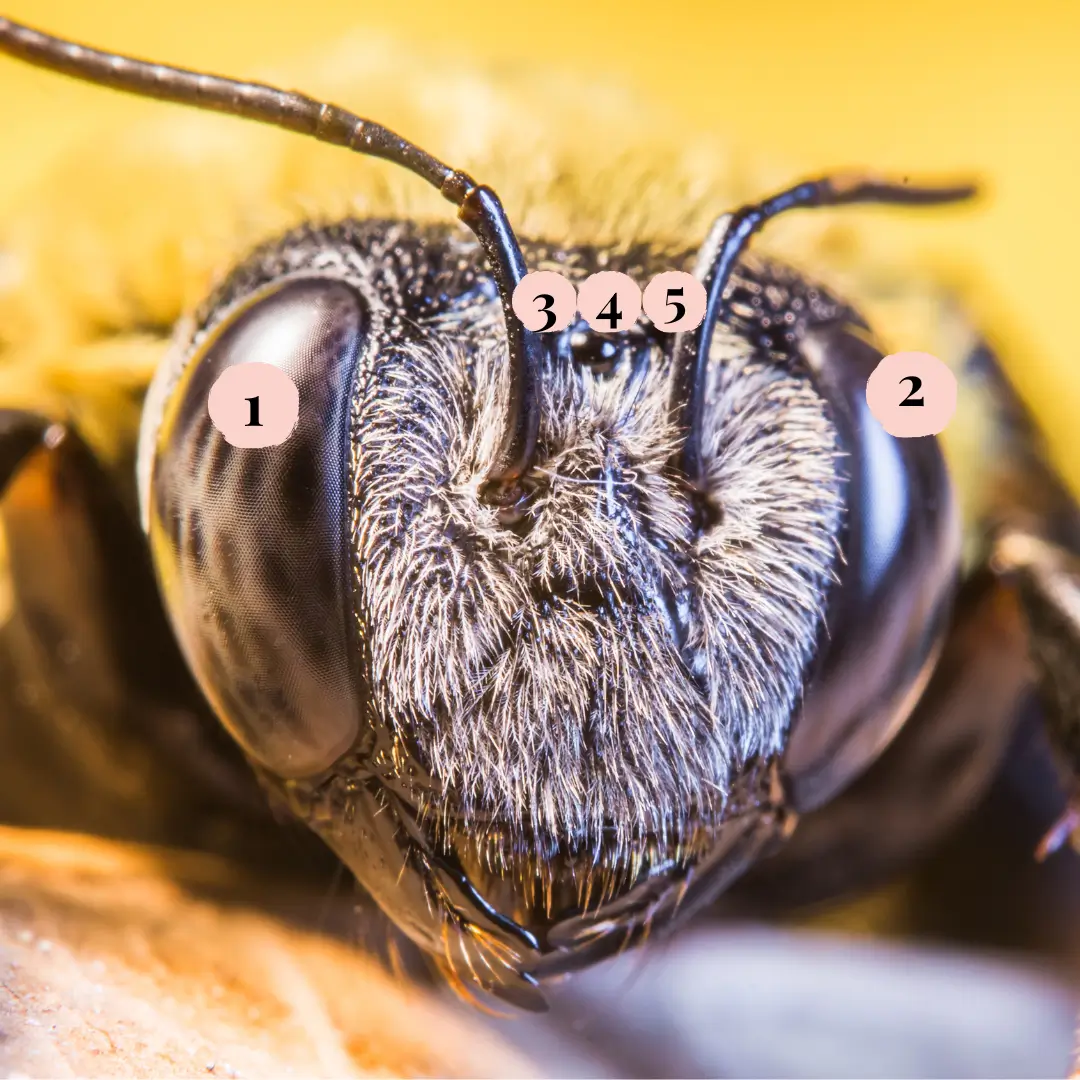
The combination of information from both types of eyes allows bees to process complex data about their surroundings. When a bee leaves the hive in search of food, its eyes help it not only find flowers but also remember the return route. This is possible due to the ability to recognise patterns and spatial orientation. In the case of honey bees, visual memory plays a key role in conveying information about the location of food sources to other members of the colony.
8. Bee families consist of up to 60,000 bees
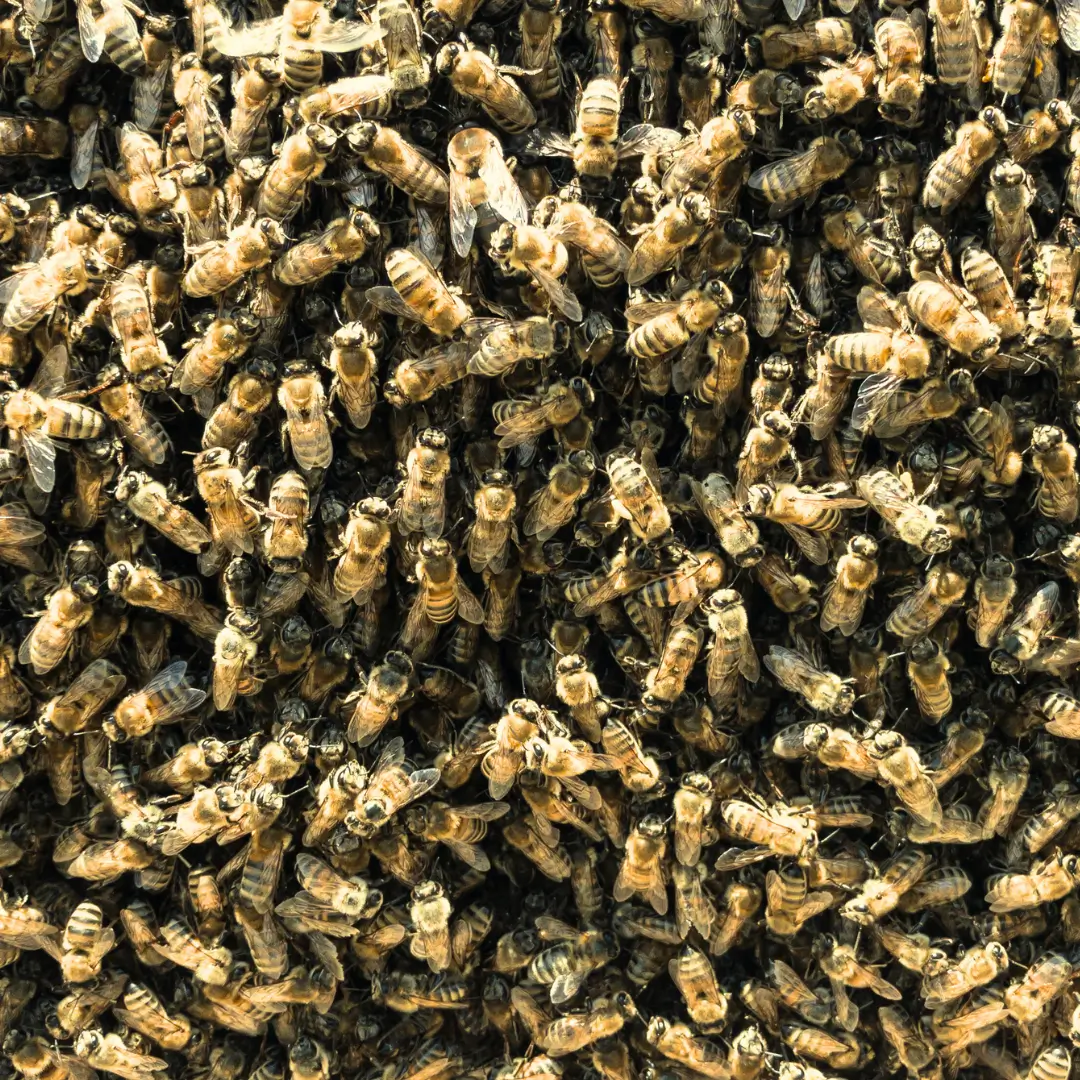
Bee families are amazing social organisms in which each bee plays its role, and their total number can reach up to 60,000 individuals at the peak of the season. Such a colony structure is a perfect example of cooperation and organisation, where every member performs a specific function to ensure the survival and development of the entire community.
The queen is the central figure in the hive and the only bee capable of laying eggs. Her main task is reproduction – she can lay from 1,000 to even 2,000 eggs a day to maintain the proper size of the colony. The queen is fed and cared for by young worker bees, who provide her with a special food called royal jelly. In exchange for this care, the queen secretes special pheromones that regulate the behaviour of all bees in the hive, synchronising their work and behaviour.
Workers are the most numerous group in the bee family, accounting for about 90% of the hive's population. They are responsible for almost all aspects of life in the colony, from collecting nectar and pollen, through building wax honeycombs, to feeding larvae and defending the hive. Their functions change with age. Young workers perform duties inside the hive, such as feeding larvae or cleaning honeycomb cells, while older workers venture outside in search of food.
Drones are males that have one main role – to fertilise the queen. Drones do not collect nectar or pollen, do not build honeycombs, and do not take part in defending the hive. After fulfilling their role, usually at the end of the season, they are driven out of the hive because they become redundant to the colony.
Every bee in the colony acts in full synchronisation with others, allowing the bee family to function effectively and survive. Thanks to this, bees are able to create honey reserves for the winter when access to food is limited. During the colder months, the bee family reduces its numbers to a few thousand individuals and huddles into a cluster to maintain heat and survive the winter.
9. Bees 'warm up' before flight
Bees, like athletes before a competition, must 'warm up' before starting a flight, especially on colder days. Since they are ectothermic insects, their body temperature depends on the ambient temperature. To be able to take to the air, they must raise the temperature of their wing muscles to about 30°C. To do this, they set their wings into rapid, shivering movements that resemble vibrations. This process generates heat, which allows them to reach the appropriate temperature necessary for efficient flight. This specific 'warming up' allows bees to effectively collect nectar and pollen even when weather conditions are unfavourable. Thanks to this skill, they can also function during colder times of the day when the temperature is too low for them to fly without previously heating their muscles.
10. Without bees, we wouldn't have one-third of our food
Bees play a key role in pollinating many plants that form the basis of our diet. About 75% of the world's crops are at least partially dependent on pollinators, including other insects, but bees are by far the most efficient among them. Their role in food production is therefore impossible to overstate.
Without bees, we would have to say goodbye to many of our favourite fruits and vegetables, and our diet would become much poorer in nutrients. It is not just a matter of taste, but also of health – many of these plants provide us with vitamins, minerals, and fibre necessary for the proper functioning of the body.
The threat of bee extinction, caused by climate change, intensive agriculture, and the use of pesticides, could have catastrophic consequences for our food production and biodiversity. That is why it is so important that we care for these beneficial insects, protect their habitats, and support sustainable agricultural practices. Without bees, the world as we know it could change drastically, and the availability of food, which we now take for granted, would become a serious problem. So let's look after bees, because by looking after them, we look after our future.
Bees are extremely important insects that play a key role in the ecosystem. They have the ability to recognise human faces and can produce as little as 1/12 of a teaspoon of honey during their lifetime. They communicate through a complex dance, and their flight speed can reach 25 km/h. During a single trip, they visit up to 100 flowers, which is crucial for plant pollination. The hive queen, whose role is central to the colony, lays up to 2,000 eggs a day. They possess five eyes that help them navigate, and before flight, they must 'warm up' by setting their wings into rapid vibrations. Without bees, we would lose one-third of our food, which is why their protection is essential for our health and survival.
Bibliography/sources:
- Bees and wasps can recognise human faces? Scientific Journal
- Leon Bornus, Beekeeping Encyclopaedia State Agricultural Publishing House, 1989
- Krystyna Czekońska, The Queen Bee, Agricultural University in Krakow [in:] Pasieka24.pl