
Bee forage in Poland- which honey varieties are produced in our country.
In the beekeeping world, a proverb originating from the east has been circulating for years: “good beekeepers are where the forage is good”. As with most proverbs we know, in this case, too, there is much truth in this statement.
Well, but what actually is all this bee forage? How do we distinguish between types and which ones are most common in our country? And finally, perhaps what is most important for us, as lovers of the bee delicacy-what impact does a given forage have on what finally ends up in our kitchen?
We will talk about this key issue in the beekeeping world in today's blog.
Table of contents:
- Bee forage- what is it?
- Bee forage- what types do we distinguish?
- Bee forage and harvest conditions.
1. Bee forage, what is it?
Bee forage, which we will talk about today, is actually nothing more than raw materials of plant origin collected by bees, used by them to produce honey and bee bread.
Bee forage, which is carried to the hive (commonly known as “flow”) is what our winged friends collect: flower pollen, nectar, as well as honeydew, which is both a raw material and food and which is processed in the hive into honey and bee bread.
2. Bee forage- what types do we distinguish?
Before we talk about specific types of forage that can be found in Poland and beyond, it is worth mentioning the key parameters that distinguish each forage, which decide to some extent on the attractiveness of a given forage for bees.
These are primarily honey yield (specifically nectar and pollen yield) as well as the blooming date and blooming duration.
Of course, as the name itself suggests, the most important issue is the aforementioned forage yield, which largely determines how large the honey harvests we can receive from a given forage. A good beekeeper must therefore, besides strictly beekeeping knowledge, be well-versed in botany and know what to expect from a given species of plants and forage.
We will say a bit more about the specific dates and lengths of plant flowering in Poland later in the post; now, let's trace what is probably the most popular division of forage, which is the one related to the flowering period itself.
For the purpose of this post, we will distinguish five of them: very early forage, early forage, mid-season forage, summer forage, and late forage.
Very early forage:
- Hazel- a plant characteristic for every beekeeper, yet beloved by bees due to the huge dose of fresh pollen during the period of their intensive development at the beginning of each season.
- Dandelion- one of the more commonly encountered plants in our country. It blooms en masse in lawns or orchards, even as early as the beginning of April. Although this forage is perhaps not very honey-producing, practically every season, significant amounts of dandelion honey, reach the Polish market and successfully find buyers.
- Honeyberry- a type of crop that has been developing very dynamically in our country recently; at the moment, however, we only offer fruit preserves from honeyberry in our offer (honeyberry juice, honeyberry syrup, honeyberry jam), as it is not easy to produce pure honey with a dominant nectar content as a forage.
The first flowers on early varieties appear as early as the end of March, when the weather in Poland can still be very changeable; consequently, attempts to obtain this type of honey succeed with rather mixed luck. The most commonly cultivated varieties are those of Japanese, Russian, and Canadian origin.
Early forage:
- Rapeseed- forage, and consequently honey, which is one of the more common, if not the most common forage in Poland. Its fields, shimmering as early as the beginning of April, are an ideal area for accumulating very large amounts of nectar and pollen.
On this common Polish forage, one of the most popular types of honey is produced- rapeseed honey. It is a honey with a pleasant aroma, changing its colour over time to creamy, sometimes practically white. Although it is not a particularly sweet-tasting honey, it is one of the honeys most liked by children.
- Highbush blueberry- also called American, is one of the species whose consumption of both fruit and the resulting blueberry honey, is constantly growing and enjoys high recognition among consumers, which means that growers and beekeepers are also paying more and more attention to it. The forage itself is not as attractive to bees as rapeseed, for example, which is why those responsible for its cultivation often pay special attention to it.
Mid-season forage:
- Acacia- actually black locust or white robinia, is a very attractive forage for our bees. An important issue in its case is the very short flowering period, which lasts an average of 8 to 12 days, and when dealing with a hot, dry summer, sometimes even shorter. This is associated with the problematic nature of its cultivation, because when the flowering period falls during capricious weather or a breakdown in weather, it is sometimes hard to get honey from this forage with such a short flowering period. Acacia honey is characterised by a very light colour, a pleasant aroma, and a long period of liquidity.
- Phacelia- one of the more attractive forages for bees. When sown early, on fertile and moist ground, it guarantees very high honey yield. From this forage, the already widely known among consumers phacelia honeyis produced, however, it has never gained such a large crowd of fans as some of the ones mentioned above.
- Raspberry- this is a forage that is a source of the much-loved by consumers raspberry honey. They come in two varieties: summer, fruiting on so-called two-year-old shoots, and autumn, which fruits on shoots of the same year, allowing for a double harvest.
Summer forage:
- Lime- we distinguish primarily two types: small-leaved and large-leaved; delicious honey most often chosen by our Customers is produced from both lime honey.
The first of these sometimes blooms up to three weeks later than its large-leaved companion but is simultaneously much more honey-yielding.
When weather conditions are favourable, lime can be a forage that serves as the main harvest of the entire season. Lime honey has over the years achieved the status of one of the more popular bee products, largely due to the strong anti-infection properties attributed to it, which unfortunately many of us face during the autumn-winter period.
Late forage:
- Heather- this is a forage known to beekeepers for decades, probably since the pre-war period. The honey produced from them, thanks to its characteristic taste qualities, has gained a wide circle of lovers over the decades. Heather honey, over the years, is becoming increasingly difficult to obtain, which is influenced both by the shrinking area of the heaths themselves and the technical difficulty, as it is a honey that is hard to spin. Its unique taste, smell, as well as the factors mentioned above, have contributed to the fact that heather honey is currently usually the most expensive honey we can buy in Poland.
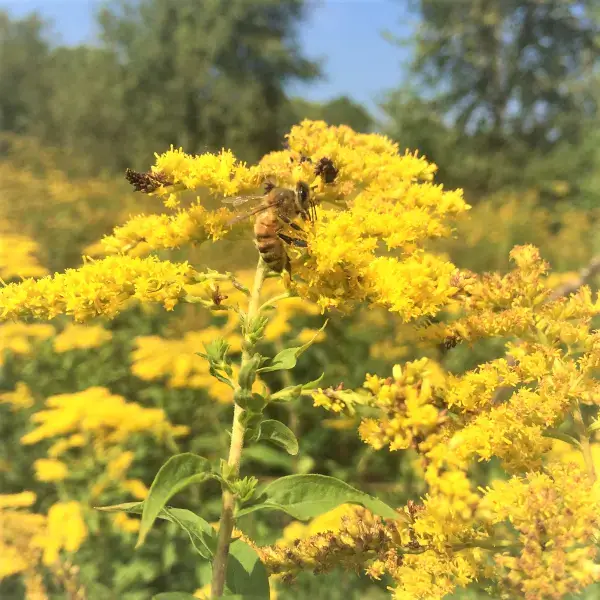
- Goldenrod- one of the relatively “newer” forages used in our country. We distinguish three types, such as Canadian, common, and late goldenrod. Goldenrod honey is characterised by an intense aroma and a slightly sour aftertaste.
3. Bee forage and harvest conditions:
Beekeepers have been planning their harvests and obtaining specific honey for years, year after year, many weeks or even months in advance. However, every more or less experienced beekeeper knows that in this case, not everything actually depends on themselves and their harvest plan.
One of the key issues is, of course, the irregularity of many plants blooming.
In Poland, over the last few years, we can very easily observe this phenomenon. The spring period, which has been surprising us with its course every year lately, high temperatures appearing quickly, lack of regularity in rainfall and its occurrence itself, mean that the result is sometimes a very short flowering period for individual plants. Sometimes, however, honey plants bloomed much earlier, but also the flowering period itself was record long. Fortunately, one of the few things that have remained constant in this regard lately is the so-called flowering sequence, i.e., the order in which plants provide bees with a given forage.
Unfortunately, in recent years, increasingly difficult-to-predict weather conditions, where changes are occurring more and more dynamically, heatwaves interspersed with significant cooling periods, drought periods followed suddenly by days of torrential, even heavy rainfall, have a negative impact on the bee forage itself, and consequently-honey production.
An extremely important issue is also the cultivation conditions in which our honey plants develop. Each forage has its “personal preferences”, the occurrence of which in a given soil area causes better harmony and honey yield of the crops.
Bibliography/Sources:
- Mieczysław Lipiński: Bee forage. Warszawa: Powszechne Wydawnictwo Rolnicze i Leśne, 2010
- lyson.com.pl/artykuly-pszczelarskie/2019/06/27/pozytki-pszczele-warte-uwagi
- pasieka24.pl/index.php/pl-pl/pasieka-czasopismo-dla-pszczelarzy/105-pasieka-1-2003/1267-poytki-pszczele
- https://www.portalpszczelarski.pl/artykul/221/glowne_pozytki_pszczele.html