
What is bee (flower) pollen
You often ask us how to use bee pollen or other bee products. All of them are gaining great popularity due to the pandemics prevailing in the world. Bee product treatments are ideal for building our body's natural immunity. It is worth paying special attention to bee pollen, as the most popular bee product, which is perfect for daily use throughout the year. We invite you to read on.
Table of contents:
- What is bee pollen?
- How is bee pollen made?
- What are the properties of bee pollen?
- How to consume bee pollen?
- Where to buy bee pollen?
1. What is bee (flower) pollen?
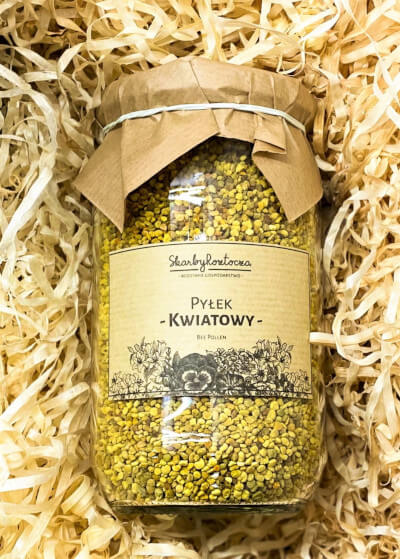
Bee pollen is a ball or granule of flower pollen collected from the field, packed by honey bee workers and used as the primary food source for the hive. It contains simple sugars, protein, minerals and vitamins, fatty acids and a small percentage of other ingredients. Also called bee bread or ambrosia. Bee (flower) pollen is found in flowering plants. Bees collect pollen while searching for nectar. Pollen can be collected from bees. It can also be collected from plants using machines. Bee pollen should not be confused with other bee products such as honey, royal jelly or honeycomb. These products may not contain pollen or other substances.
2. How is bee pollen made?
Bee pollen is a ball of pollen produced by young bees when they land on a flower. It is a mixture of pollen, saliva and nectar or honey. Bees carry these balls back to the hive in bags on their legs and store them in the hive's honeycomb. The pollen then ferments into 'bee bread', which feeds the bee colony. The formation of bee pollen is a natural process when running an apiary, however, bee production can often be focused on other products from the hive :)
3. What are the health properties of bee pollen?
Bee pollen is collected as food for humans and known for various proven health benefits. Its exact composition varies. This depends on the plant from which the pollen was taken. The protein contained in bee pollen is more difficult to digest than other protein sources. Bee pollen has an impressive nutritional profile.
It contains over 250 biologically active substances, including proteins, carbohydrates, lipids, fatty acids, vitamins, minerals, enzymes and antioxidants.
Bee pollen granules consist of approximately:
Carbohydrates: 40%
Protein: 35%
Water: 4–10%
Fats: 5%
Other substances: 5–15%
This last category includes vitamins, minerals, antibiotics and antioxidants.
It should be remembered that the health properties of flower pollen and its nutritional content depend on the source of the plant and the season. For example, studies have shown that bee pollen collected from pine contains about 7% protein, while pollen collected from date palm packets is closer to 35% protein. Furthermore, bee pollen collected in spring has a significantly different amino acid composition than pollen collected in summer.
The high antioxidant content protects against free radicals and chronic diseases. Bee pollen is loaded with a wide range of antioxidants, including flavonoids, carotenoids, quercetin, kaempferol and glutathione.
Antioxidants protect your body against potentially harmful molecules called free radicals. Damage caused by free radicals is linked to chronic diseases such as cancer and type 2 diabetes. Test-tube, animal and some human studies have shown that bee pollen antioxidants can reduce chronic inflammation, eliminate harmful bacteria, fight infections and combat the growth and spread of tumours. However, the antioxidant content of bee pollen also depends on the plant source.
4. How to use bee pollen?
Bee pollen is sold in the form of natural granules, which can be measured and taken with a teaspoon. You can also mix it with other foods such as muesli or yoghurt or make smoothies with it. It usually has a bitter taste, although people who take it regularly seem to get used to it.
The most popular ways to use bee pollen:
Method 1- 1 tablespoon of pollen should be placed in lukewarm water in the evening- consume on an empty stomach in the morning. In this way, we will achieve even 8-10 times greater bioavailability. This method is supported by the largest amount of literature in the field of apitherapy.
Method 2- 1 tablespoon of pollen should be added to yoghurt, oatmeal, kefir at least half an hour before consumption in order to dissolve the pollen.
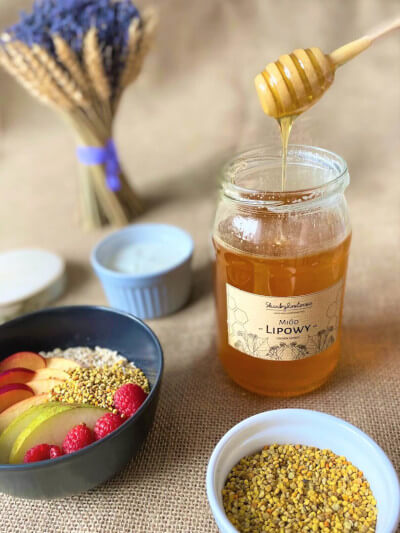
Our suggestion for oatmeal with bee pollen:
- 1 cup of natural yoghurt
- 4 tablespoons of oat flakes
- ½ nectarine
- ½ apple
- ¼ pear
- 4 raspberries
- 2 teaspoons of linden honey
- 1 teaspoon of flower pollen
Finely dice the fruit or cut into strips. Pour the yoghurt into a bowl, add the oat flakes, arrange the fruit, and add the flower pollen. Drizzle generously with linden honey.
5. Where to buy bee pollen?
For the best Polish pollen, we invite you to our online shop :) Why the best? Our pollen has been properly frozen and dried to meet quality standards. What's more, we offer a mixture of pollens from the entire season - thanks to this, the pollen has a unique multi-coloured appearance and a very pleasant taste. It is worth mentioning that using our domestic pollen means we are dealing with the same allergens we encounter daily. This gives us the certainty that the pollen will not negatively affect our health and we will avoid previously unknown allergies or allergic reactions. If you are wondering where to buy bee pollen we invite you to go to the bee pollen page by clicking the link here.
We cordially invite you to shop with us.