
The colour of honey - and the crystallization process.
Have you ever noticed that honey, which was initially dark and liquid, becomes lighter and more matte when it starts to crystallize? This phenomenon may seem mysterious, but it is completely natural and results from the unique properties of honey. In our article, we will explain why liquid honeys are usually darker and how the crystallization process affects their colour and structure.
In this post, you will learn what makes crystallized honey look different, yet still retain its valuable nutritional and health properties. We encourage you to read the post to find out how the crystallization process changes the colour of honey.
Table of contents:
1. Natural colour of liquid honey.
2. The crystallization process and colour change.
3. Chemical composition and its impact on colour.
4. Impact of impurities and pollen.
1. Natural colour of liquid honey.
Liquid honeys usually have a darker colour. For example, Acacia Honey, despite being one of the lighter honeys, still has a distinct colour when in liquid form. The colour of honey depends on many factors, including the source of nectar (type of plant), the presence of various chemical compounds such as carotenoids and flavonoids, as well as storage conditions.
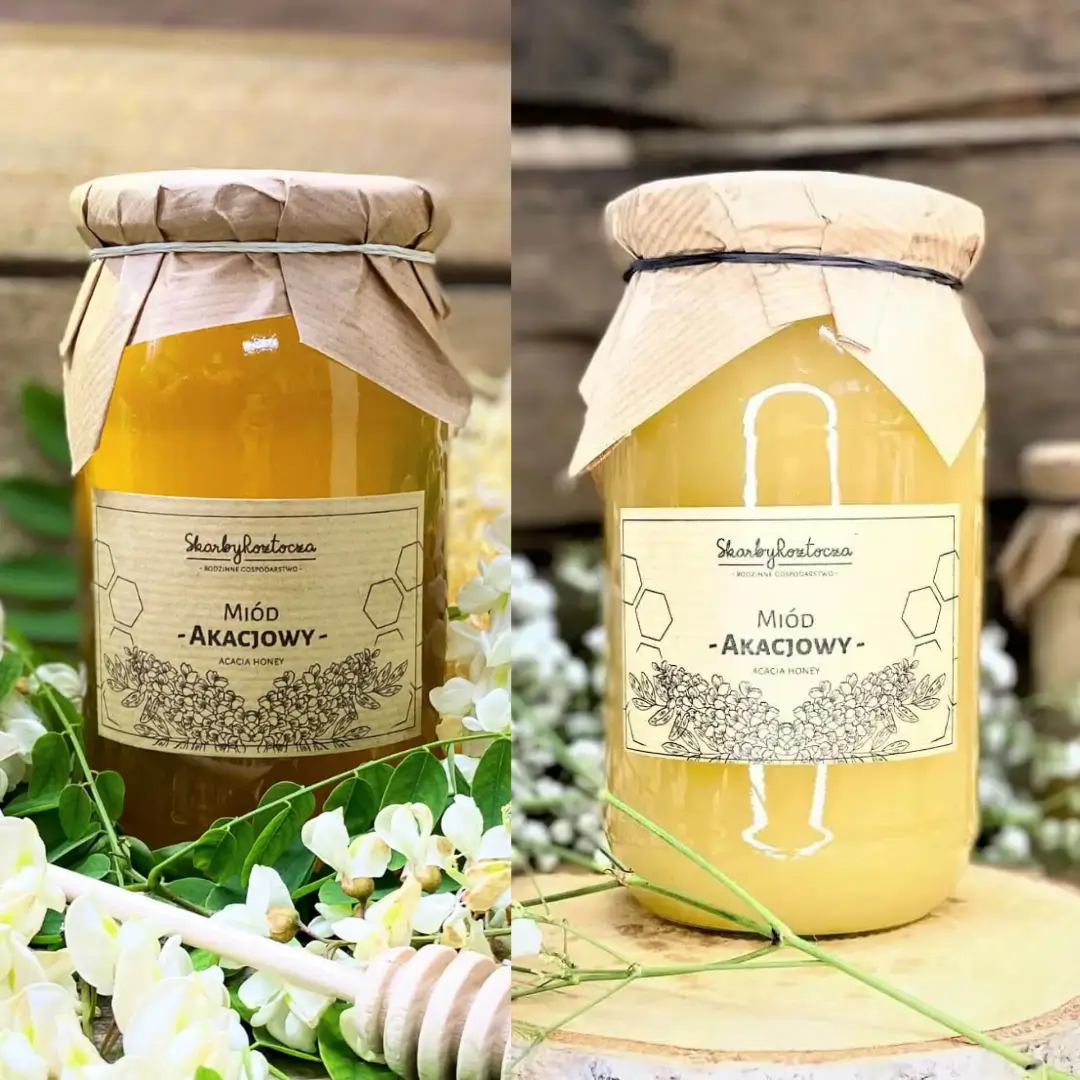
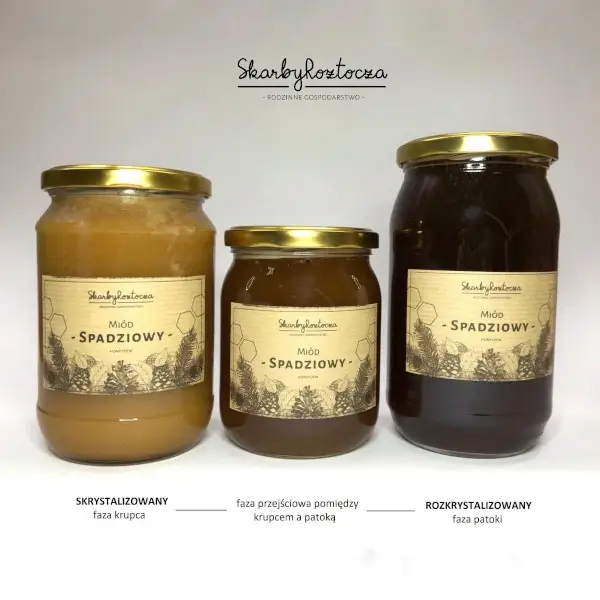
When honey begins to crystallize, its colour often changes, becoming lighter and more matte. This happens for several reasons. Firstly, liquid honey has a higher water content, which affects its colour and transparency. As crystallization occurs, water molecules are bound in sugar crystals, causing the honey to become more cloudy and lighter.
Sugar crystals in crystallized honey scatter light in different directions, which makes the honey appear lighter. In its liquid state, honey absorbs and transmits light in a more uniform way, causing it to look darker. Furthermore, liquid honey has a smooth, uniform structure that absorbs more light, while crystallized honey has a structure that reflects light, making the colour appear lighter.
The presence of pollen particles and impurities also matters. In liquid honey, pollen particles and other microscopic impurities can be evenly dispersed, adding to its darker appearance. During crystallization, these particles can be enclosed within the sugar crystals, reducing their impact on the honey's colour.
The change in honey's colour during crystallization is a natural process that does not affect its quality or nutritional value. On the contrary, crystallized honey still retains its health properties, and in some cases, it can even be easier to spread on bread or add to tea. It is therefore worth remembering that the lighter colour of crystallized honey is nothing more than the result of natural processes occurring in this extremely healthy and valuable product.
2. The crystallization process and colour change.
During crystallization, honey usually becomes lighter. This is because the crystallization process causes the formation of small glucose crystals that scatter light. The scattering of light by these tiny crystals makes the honey appear more matte and lighter than in its liquid form. This is similar to the effect we observe with sugar – granulated sugar is lighter than the same sugar in the form of liquid syrup.
As crystallization progresses, water molecules in the honey are bound in the sugar crystals, which affects the change in its consistency and appearance. Liquid honey contains more free water, giving it a darker and more transparent look. As water is absorbed by the sugar crystals, the honey becomes more cloudy and its colour lightens.
The change in honey's colour during crystallization is therefore a normal phenomenon, resulting from natural chemical processes occurring in the honey. Regardless of its state – liquid or crystallized – honey remains a valuable and healthy product that can be consumed in many different ways.
3. Chemical composition and its impact on colour.
The chemical composition of honey has a significant impact on its colour. In the liquid state, the main sugars in honey - glucose and fructose - are dissolved in water, which allows for more uniform absorption and reflection of light. This phenomenon gives the honey a darker colour because light passes through the transparent liquid and is partially absorbed by dissolved chemical compounds, such as carotenoids and flavonoids, which are responsible for the honey's colour.
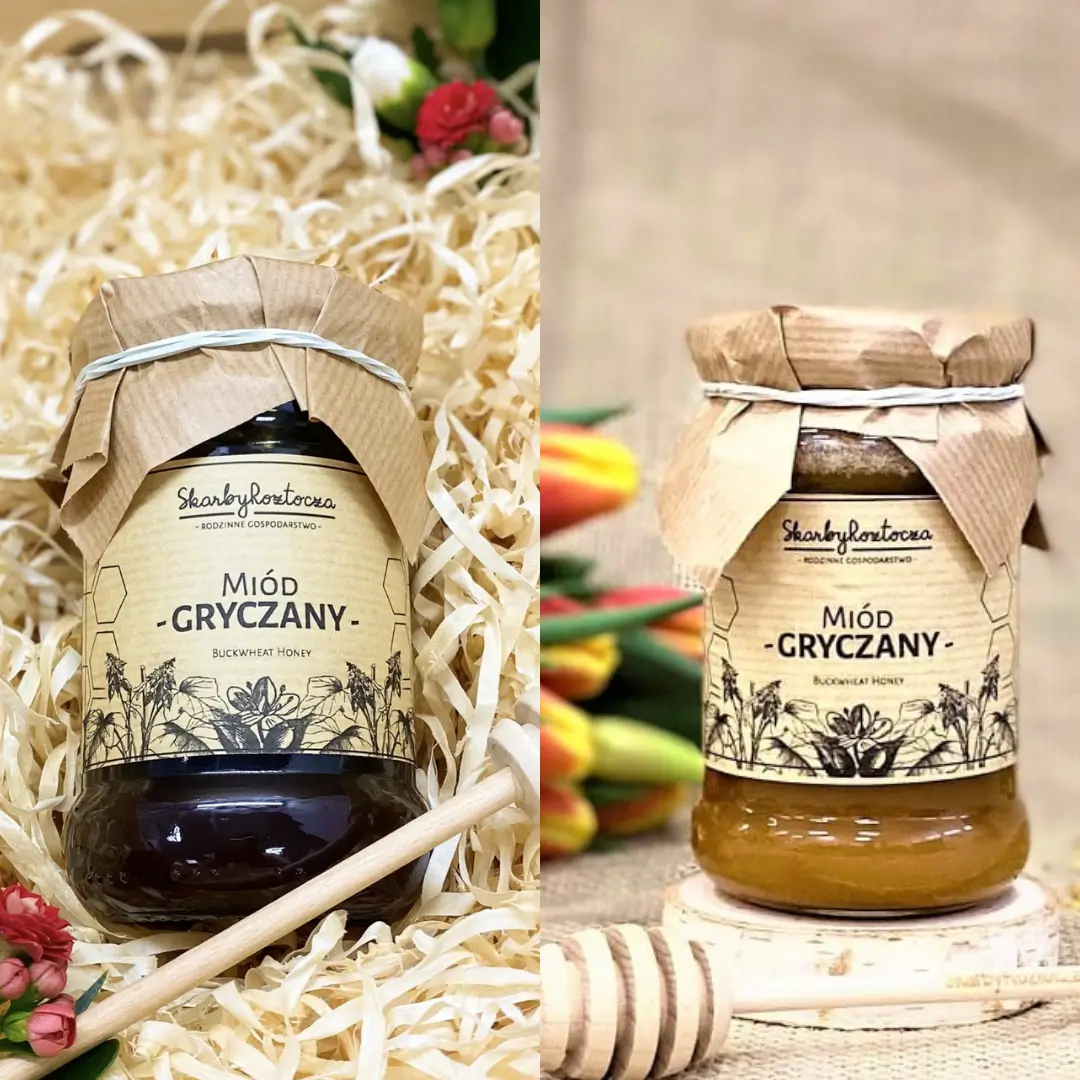
In addition, other chemical components of honey, such as proteins, organic acids, and minerals, can also affect its colour. In darker honeys, such as Buckwheat Honey or Honeydew Honey, the higher content of these compounds can contribute to a more intense colour. As honey crystallizes, these chemical compounds can become "trapped" in the sugar crystals, which also affects the change in colour.
4. Impact of impurities and pollen.
The impact of impurities and pollen in honey on its colour is significant. In the liquid state, honey contains various particles such as pollen, wax fragments, propolis, and other microscopic impurities. These particles can affect the honey's colour, giving it a darker shade. The presence of pollen is particularly important as it contains natural pigments that can intensify the honey's colour.
When honey begins to crystallize, its internal structure changes. This process causes the sugar crystals to surround and "enclose" the pollen particles and impurities within their structure. As a result, the dispersion of these particles in the honey becomes less visible, contributing to the lighter appearance of crystallized honey.
The crystallization process also helps in preserving the honey. By enclosing impurities and pollen particles in the sugar crystals, the honey becomes less susceptible to fermentation and the growth of microorganisms. This is a natural way to extend the shelf life of honey while preserving its nutritional and medicinal values.
5. Summary
Liquid honeys are usually darker due to the uniform dispersion of light by dissolved sugars and other compounds. During crystallization, honey becomes lighter because glucose crystals scatter light, giving it a matte appearance. The change in colour is a natural process and does not affect the quality or health properties of the honey, but merely testifies to its natural origin.