
Can honey be good for allergies?
If you have ever suffered from allergies, you know how bothersome the symptoms can be - sneezing, an itchy nose, watery eyes. The search for natural ways to alleviate these ailments has become increasingly popular. One solution that is attracting interest is honey. But can it really be an effective remedy for allergies? In today's article, we will take a closer look at this issue.
Can consuming wildflower honey from your local region act as a natural vaccine during desensitisation? Research suggests there is potential for using honey as a natural desensitising vaccine for people with inhalant allergies. Scientific literature contains reports on this subject, highlighting the content of wind-pollinated plant pollen grains in honey, which may have an immunogenic effect on the body. Using honey containing naturally occurring pollens from allergenic plants, especially during months with low concentrations of these pollens in the air, may contribute to alleviating typical allergy symptoms during the next pollen season through an immunostimulatory effect.
Mechanism of honey's action in the context of allergies
There is a theory that consuming local honey can help alleviate seasonal allergy symptoms. According to this theory, honey contains trace amounts of plant pollen responsible for allergies. Regular consumption of such honey may gradually strengthen the body and reduce the allergic reaction by building immunity to these allergens. Although there is little scientific evidence confirming the effectiveness of this action, we provide more information about it below.
Honey for allergies - research and confirmations
Studies conducted, including on a group of patients from the Malay Peninsula, showed that systematic honey consumption resulted in a reduction in seasonal allergic rhinitis (SAR) symptoms. In this study, the test group took 1 g of honey daily for 4 weeks, while the control group received a placebo. The results showed that only the group consuming honey exhibited a reduced number of SAR symptoms, and the improvement persisted even after the treatment stopped. The study's authors emphasize that systematic honey consumption can improve overall and individual SAR symptoms, suggesting its potential as a complementary therapy in allergy treatment.
Additionally, studies conducted in Finland in 2011 also confirm the effectiveness of pollen contained in honey in treating inhalant allergies. Assessments of the effects of using local honey enriched with birch pollen in people allergic to this pollen showed promising results.
In conclusion, although further research is needed, there is promising evidence that honey can be an effective complementary therapy in treating inhalant allergies. However, before taking any therapeutic action, it is recommended to consult a doctor or specialist.
Which honey to choose for allergy sufferers?
If you are wondering whether honey can help alleviate allergy symptoms, it is worth remembering that not all honeys are the same. If you want to test this theory, choose local honey collected in the area where you live. Such honey likely contains a higher amount of plant pollen present in your environment to which you are susceptible to an allergic reaction. However, remember that consulting a doctor or allergy specialist is always recommended before making any decisions regarding allergy treatment.
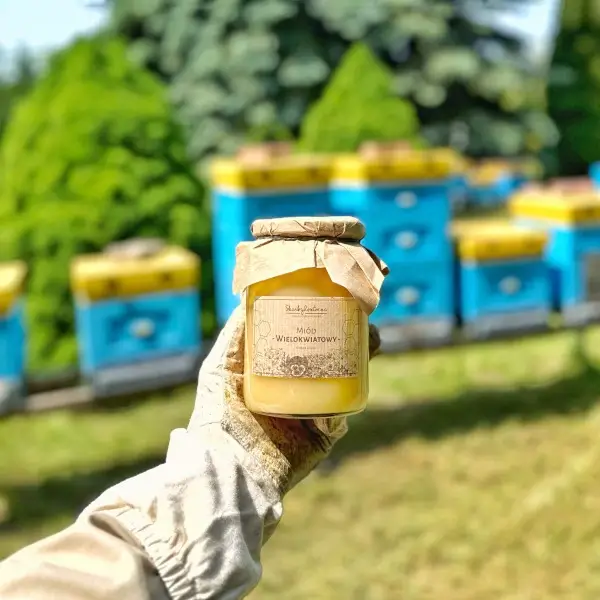
If you are wondering which honey to choose for allergy sufferers we especially recommend wildflower honey. Most often, it is this type of honey that receives attention in the case of ailments related to allergic reactions to pollen.
Summary
Although there is a theory about the potential beneficial effect of honey on allergies, scientific evidence for this is limited. It cannot be unequivocally stated that honey is an effective remedy for allergies. Nevertheless, choosing local honey can be a safe and tasty way to support a healthy lifestyle, and perhaps also bring some benefits for allergy sufferers. However, before taking any action, consultation with a doctor or specialist is recommended.
P.S. Do you prefer knowledge in the form of a video? Watch our short video on how honey affects allergies.

Sources/ Bibliography:
Asha'ari Z.A., Ahmad M.Z., Jihan W.S., Che C.M., Leman I. Ingestion of honey improves the symptoms of allergic rhinitis: evidence from a randomized placebo-controlled trial in the East coast of Peninsular Malaysia. Ann Saudi Med. 2013
Burzyńska Marta, Wildflower honey – universal or unique? Pasieka 24 Publishing House, 2/2024