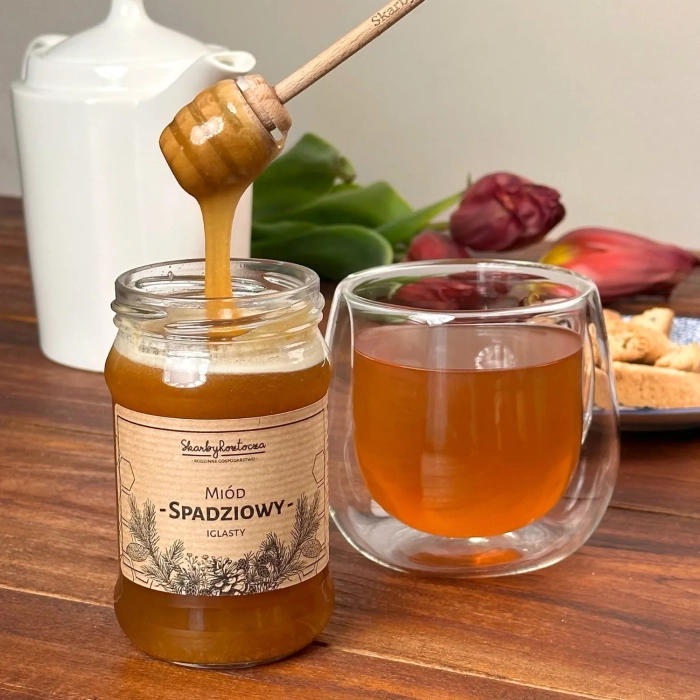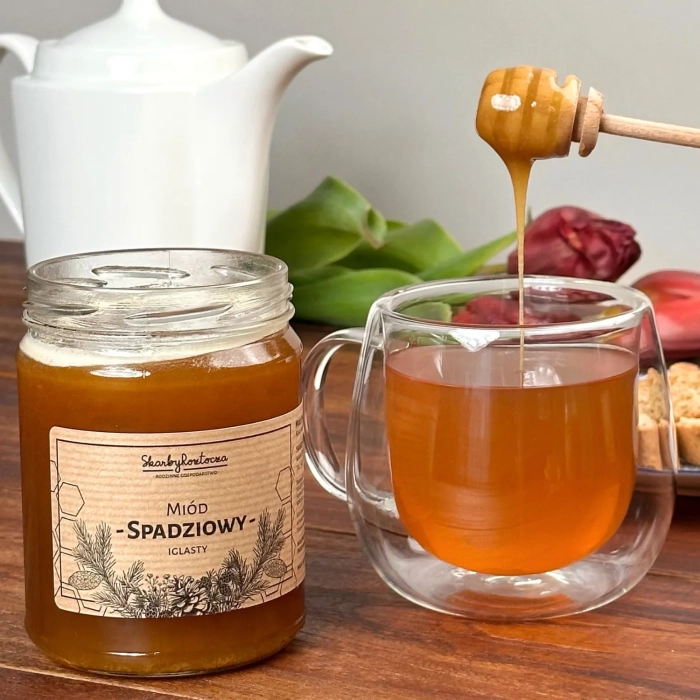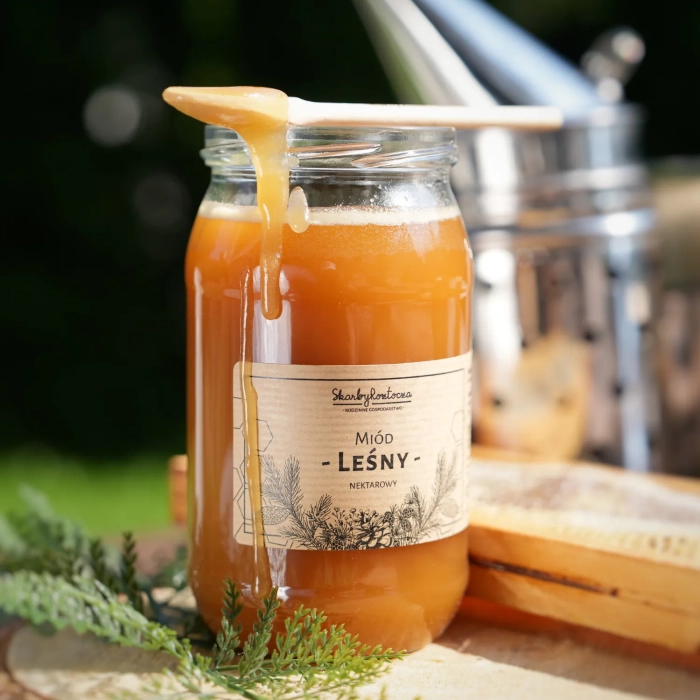

How to properly store honey and bee products?
How to store honey? What conditions to provide for honey? Can honey go bad?
We often get such questions and we are glad that this topic interests you, because many people still store this bee treasure incorrectly, and to fully benefit from its qualities, it is worth taking care of appropriate storage conditions.
In this blog post, we will look at this topic and explain how to take care of our treasures from the hive! We invite you to read on.
Table of contents:
1. Definition of honey and its types.
2. The process of honey production and enzymes contained in honey.
3. Impact of temperature on honey.
4. Impact of sunlight on honey.
5. Impact of humidity on honey.
6. In which room to store honey?
7. Storage of dry bee products.
8. Summary.
1. Definition of honey and its types.
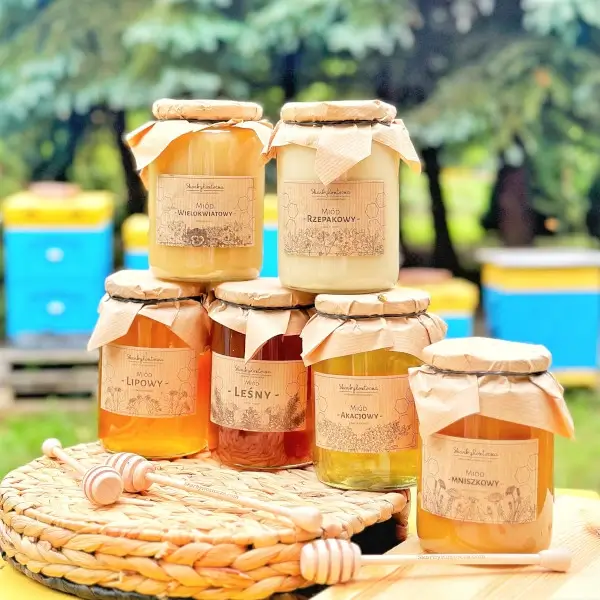
Honey - by definition, and more precisely a legally protected name for a naturally sweet foodstuff loved by many, produced by honeybees. It can only be produced by these brave insects - there is no question of human interference here. That is perhaps the whole secret of this bee treasure or liquid gold, as some call it. Bees can produce it from plant nectar - in the case of nectar honeys, and secretions of living parts of plants, or secretions of insects sucking living parts of plants in the case of honeydew honeys. It also happens that bees use both of these resources, creating equally unique nectar-honeydew honeys.
2. The process of honey production and enzymes contained in honey.
Crucial, however, is the very process of honey creation - between gathering the forage and the finished honey. It is processed by combining and adding bee enzymes, then stored, dehydrated, accumulated and left in the honeycomb cells to ripen.
It is these enzymes contained in honey that constitute one of the greatest values of this bee product, and it is precisely for the sake of preserving them that every effort should be made to ensure our honey has the best storage conditions, and it will reward us with its biotic and medicinal properties.
3. Impact of temperature on honey.
The key quality factor in natural and raw honey is temperature, so in this paragraph we will focus on the impact of temperature on honey.
A temperature of over 50 degrees Celsius destroys the live biotic bodies contained in honey, which is why it is so important not to add it to hot drinks, as we then strip it of its most valuable health qualities. In the hive, we naturally register temperatures up to 42 degrees, but usually during the season in the nest it fluctuates around 35°C and is related to brood rearing. It is therefore good practice not to exceed 40 degrees Celsius when using honey, but after its extraction and storage outside the hive, much lower storage temperature conditions must be maintained.
After removing the frames from the hive, the honey is centrifuged and then poured into packaging. Honey prepared in this way should be tightly closed and placed in a dry, cool and shaded place.
But what is a cool place? Good practice is to store honey at a temperature between 8 and 18 degrees Celsius. A temperature of approx. 14-18°C will favourably influence the crystallization process, while at temperatures from approx. 25 to 40 degrees, the honey will liquefy and transition into a liquid state. The Polish standard PN-88/A-77626 regarding honey storage conditions indicates that the temperature should not exceed 18 degrees Celsius.
4. Impact of sunlight on honey.
A note about a place without access to sunlight is also often added - this is also a very important aspect and will also protect the honey from temperature differences on its surface, as well as secure it against unwanted changes such as the activation of naturally occurring yeasts in the honey and the start of fermentation processes, which unfortunately consequently excludes it from direct consumption.
To sum up, according to good practice and the standards presented, a place should be provided that is not only cool but also shaded in order to avoid the negative impact of sunlight on honey and to ensure its natural health properties.
5. Impact of humidity on honey.
Mature honey contains about 80% simple sugars and about 16-20% water, so it can be called a supersaturated sugar solution. Such a solution, due to its high density and low water content, tends to absorb water from the environment. Honey therefore has hygroscopic properties, which means it strongly absorbs moisture, and an above-normal water content can lead to unfavourable changes in it, from thinning of the product, through its separation, to the activation of naturally occurring yeasts leading to its fermentation.
It is therefore so important to store honey in tight packaging and ensure proper storage conditions due to the significant impact of humidity on honey. For the room in which the honey is located, according to the Polish standard, the relative air humidity should be within the range of 65-75%.
6. In which room to store honey?
Knowing the requirements and preferences regarding temperature and humidity, attention should be paid to in which room to properly store honey. In determining and adapting it, we can also use the non-obligatory but accurate Polish Standard “PN-88/A-77626” regarding the storage of bee products - according to which the room should be dry (as per the previous point), sufficiently airy and free from foreign odours (having efficient ventilation) and additionally it is worth it having protection against pests (such as flies, wasps, moths, ants or mice). The room should be clean, the shelves on which products are stored should be easily washable, and the floor itself clean and dust-free, so that dust or dirt is not found on food products. The storage place for bee products should not have direct access to sunlight and should have a constant temperature not exceeding 18 degrees Celsius.
In home conditions, the best place to store honey will be choosing a cool cellar, garage or pantry, but if we do not have such rooms at home and we like to have honey always at hand, a good solution will also be keeping it in the fridge. Here you just need to remember to screw the jar on tightly, because honeys, as we mentioned earlier, are strongly hygroscopic, but also absorb other smells very well. When keeping honey in the kitchen, choose cabinets as close to the floor as possible, ensuring appropriate temperature comfort and a low level of moisture.
Avoid places close to devices that emit heat, such as a radiator, oven or a cabinet next to the fridge, as well as sunny windowsills and kitchen countertops.
7. Storage of dry bee products.
And what about storing precious bee products such as pollen, bee bread or propolis? Their greatest enemy is moisture and microorganisms, so also let's ensure a place that is primarily dry, but also cool and without access to sunlight. A fridge or a cool cellar will also be a good place here, but when storing and using them, remember to close them tightly to also protect them against microorganisms. The discussed products can also be successfully frozen without fear of losing their nutritional value.
8. Summary.
In the summary, we will touch upon a quite simple but important matter - read the labels and the recommendations regarding food storage included on them by manufacturers. Taking care of appropriate storage conditions for bee products will allow us to enjoy high-quality bee products, preserving all their nutritional values and, above all, biotic-medicinal properties, thanks to which these are not only food products but also medicinal products!
Remember that natural honeys are live and raw products - they are not pasteurised, nor are any artificial preservatives added to them. Failure to comply with the recommendations for storing bee products can deteriorate their quality and in some cases even lead to permanent defects in the product excluding them from direct consumption.

Bibliography / Sources:
- Activities of WIJHARS in Olsztyn - “Honey – what is worth knowing” (Author: Małgorzata Staniszewska) Text published in Wiedza i Jakość No. 3 (60)/2020 (https://www.gov.pl/web/wijhars-olsztyn/miod-co-warto-wiedziec)
- Art. 2 of Commission Implementing Regulation (EU) 2021/405 and Art. 2 point 34 a) and 34 b) of Regulation (EU) 2022/2292
- ULmonitor article Pasieka 24.pl (https://pasieka24.pl/index.php/pl-pl/aktualnosci/wiadomosci-z-polski/1843-ulmonitor)
- Ostrowska W. 1998. Beekeeping management. Warsaw, PWRiL
- Wilde J. Prabucki J. 2008. Bee breeding. Poznań, PWRiL
- pasieka24.pl - Beekeeping facts and myths - art. “MYTH: It is not worth heating bee colonies because it can harm them”
(https://pasieka24.pl/index.php/pl-pl/biblioteczka-pszczelarza-z-pasja-ksiazki-pasieki/230-k2500-pszczelarskie-facty-i-mity/3212-s032-mit-nie-warto-podgrzewac-rodzin-pszczelich-poniewaz-moze-im-to-zaszkodzic)
- https://www.portalpszczelarski.pl/artykul/1021-temperatury-w-ulu-a-zycie-pszczol
- Polish Standard PN-88/A-77626 Bee honey warehouses for honey storage
(https://www.gov.pl/web/ijhars/przepisy-okreslajace-jakosc-handlowa-miodu)
- https://pasieka24.pl/index.php/pl-pl/biblioteczka-pszczelarza-z-pasja-ksiazki-pasieki/71-wszystko-o-pylku-i-jego-pozyskiwaniu/725-cz-5-przechowywanie-pylku
- https://www.miod.pl/jak-przechowywac-pylek-pszczeli-i-pierzge/