
To what temperature can honey be heated without losing its properties?
Fresh honey right after harvesting is usually liquid and easy to pour. However, over time, it naturally begins to crystallise, changing its consistency to a more solid state. This process is completely natural and proves the authenticity of the honey, but at the same time, it makes storage and portioning difficult, especially when the honey is stored in large drums. To facilitate further processing and ensure customers have access to liquid honey all year round, beekeepers use decrystallisation – gentle heating of honey in special devices that allow for the preservation of its nutritional values and health properties.
Want to find out to what temperature honey can be heated so that it doesn't lose its properties - and why it's done? We invite you to this short blog post!
Table of contents:
1. Why do beekeepers decrystallise honey?
2. To what temperature can honey be safely heated?
3. What does decrystallisation look like in practice?
1. Why do beekeepers decrystallise honey?
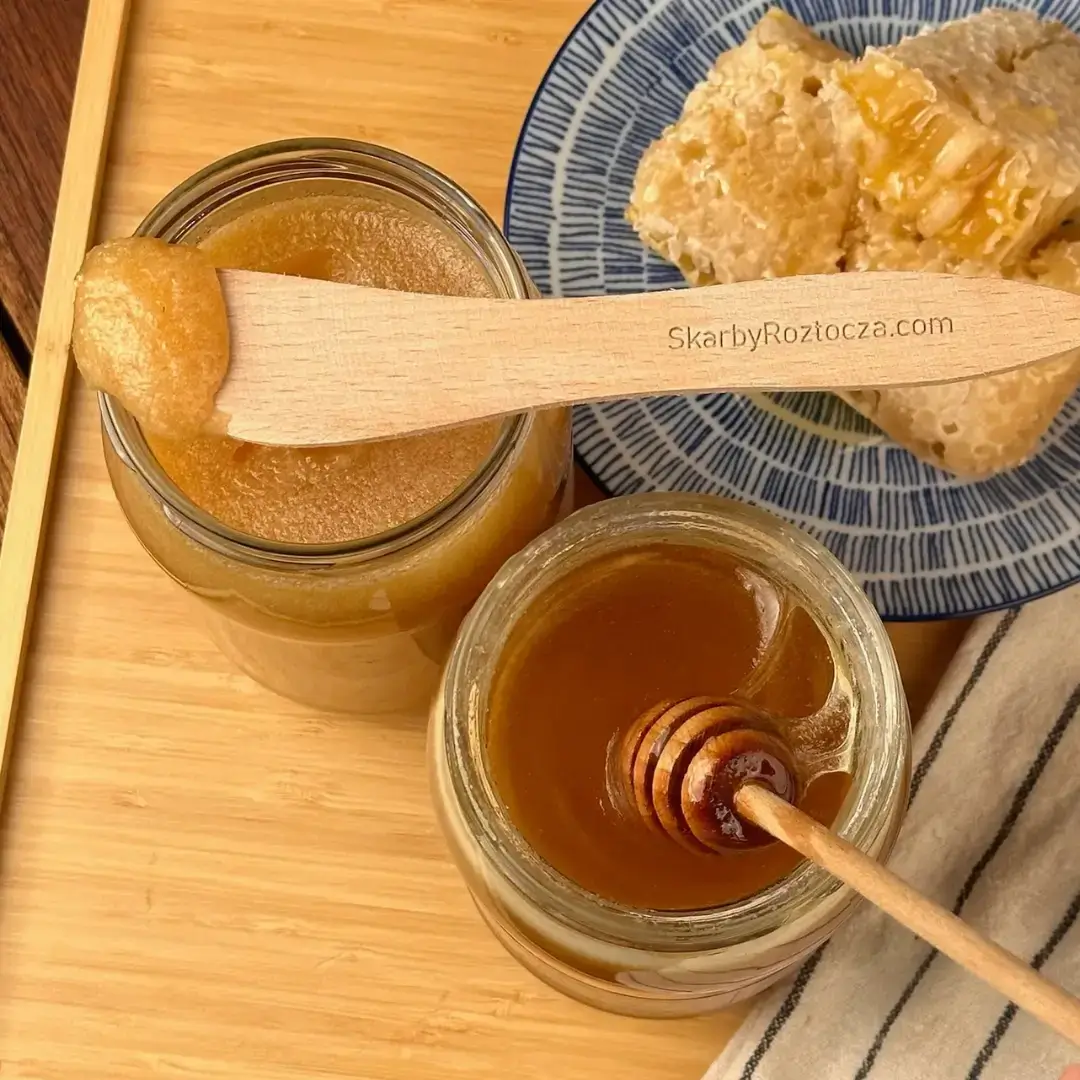
Immediately after harvesting, fresh honey is usually liquid, slightly sticky and shiny. This form is due to the natural water content and the appropriate proportions of simple sugars. In this state, honey is easy to pour, but over time – within a few weeks or months, depending on the type of honey – it gradually begins to crystallise. Crystallisation is the result of the predominance of glucose over fructose – the higher the glucose content, the faster the honey crystallises.
Although from the point of view of nutritional value, crystallised honey is just as valuable as liquid honey, its consistency significantly complicates the beekeeper's work. This particularly applies to honey stored in large containers, such as steel or plastic drums with a capacity of 200–300 kilograms. In such a form, it is difficult to extract, portion or pour into jars – especially when smaller portions in various weights are needed.
That is why beekeepers are increasingly reaching for specialised technological solutions. One of them is a decrystalliser – a device designed for the gradual, gentle heating of honey located in the drum, allowing for a temperature close to that which naturally occurs in the hive- exactly as bees do in the hive :) In contrast to traditional heating, a decrystalliser maintains a constant, safe temperature (up to a maximum of 40°C), which allows for the preservation of the biological properties of honey. This process lasts from several dozen hours to several days, depending on the type of honey, the degree of crystallisation and the volume of the batch.
Liquefying honey in the drum gives the beekeeper great flexibility. He can pour the honey into various capacities at any time of the year – for example, 370 g, 650 g or 1000 g jars – depending on demand.
Furthermore, storing honey in large containers until the moment of bottling limits the need for storing finished products, which is particularly important for larger apiaries. Thanks to this, the entire distribution process can be better planned, and the customer receives honey in its optimal form.
2. To what temperature can honey be safely heated?
Honey is a product very sensitive to temperature, which is why any processes related to its heating must be conducted carefully and with full awareness. For honey to retain its natural properties, its heating temperature should not exceed 40 degrees Celsius. In practice, it is assumed that the limit of absolute safety is the range of 40 degrees, where the lower the temperature, the better for the quality of the product. It is in this range that honey retains its full biological value – it does not lose valuable enzymes such as invertase or diastase, which are responsible, among other things, for antibacterial and digestion-supporting properties. Within this same range, honey also maintains its natural aroma, delicate taste, and the vitamins and active compounds it contains, which support immunity and have anti-inflammatory effects.
Heating honey above this temperature can bring negative consequences. Already upon exceeding 45 degrees, the gradual destruction of enzymes begins, and along with them, the overall quality of the honey decreases. This process occurs faster the higher the temperature and the longer its duration. At temperatures above 60 degrees, most of honey's health-promoting properties are irretrievably lost – the honey ceases to have a bactericidal effect, loses natural antioxidants and becomes merely a sweet substance with taste values, but without health benefits.
This is precisely why properly conducted decrystallisation, carried out in a slow and controlled manner, is of such vital importance.
3. What does decrystallisation look like in practice?
The process of honey decrystallisation begins at the stage of its storage. After harvesting, fresh honey goes into large containers, most often drums with a capacity of several hundred kilograms. This is a convenient and economical solution that allows for the storage of larger quantities of the product for a longer time. In such conditions, honey begins to naturally crystallise – it changes its consistency from liquid to a more solid, lumpy one. Crystallisation is a natural and inevitable process that proves the authenticity of the honey, however, it complicates its further processing, especially when it comes to bottling into smaller packaging.
When the moment comes to prepare the honey and pour it into jars, the beekeeper reaches for a special device called a decrystalliser. This is equipment that enables the gentle and even heating of honey located in the drum.
The temperature is maintained at a level not exceeding 40 degrees Celsius, which is crucial for preserving the valuable properties of honey. Heating takes place slowly and evenly, often lasting from a few hours to even a few days, depending on the size of the drum and the type and degree of crystallisation of the honey. Thanks to this process, the honey becomes completely liquid again, while simultaneously not losing its natural enzymes, vitamins and aromas.
After decrystallisation is complete and a liquid consistency is obtained, the honey is ready for bottling. In this form, it can be easily portioned and poured into jars of various capacities.
Thanks to this, customers have the opportunity to choose packaging tailored to their needs.
This entire process combines traditional honey storage methods with modern technologies that allow for the preservation of its quality and freshness, while simultaneously facilitating its distribution and daily use by consumers.
4. Summary:
Honey can be safely heated to the same temperature that prevails in the hive – approx. 36 degrees Celsius, thanks to which it retains its valuable enzymes, vitamins and natural taste and aroma. Such gentle heating, or decrystallisation, is necessary to liquefy honey collected in large drums, which significantly facilitates its storage and subsequent bottling into jars of various capacities - exactly as bees do in the hive :)
Source/Bibliography:
- Honey without secrets – a practical guide to using bee products https://ksow.pl/files/Bazy/Biblioteka/files/Miod_bez_tajemnic._Praktyczny_poradnik_stosowania_produktow_pszczelich.pdf
- Baczmiański J., Gruszczyński R., Honey is health, „Ekonatura” no. 10, Polish Centre for Education, Promotion of Ecological Products and Equipment Ekonatura Association, Wrocław 2008, pp. 8-9.
- Trzybiński S., All about honey and its storage, Pasieka24.pl Publishing