
Every one of us can name at least a few types of honey. There are truly many types of this health-promoting product. Every region of Poland and the world can have different types of honey. How to find your way through this? Which one will be best for us?
This is a question with no straightforward answer. Due to the wide range of applications and medicinal properties of honey, it is worth comparing available types of honey and choosing those that best suit our needs or simply our palate :)
In this article, we will try to describe the most popular types among Polish natural honeys. We hope that thanks to this, each of you will find your favourite honey and will be able to benefit from their precious health properties.
Happy reading :)
The subject of this article is very extensive. Considering the best way to differentiate the honeys known to us, we decided to describe each of them based on available scientific literature. A concise form containing the most important information should be enough to effectively compare so many types of the discussed gift of nature.
We will present them in the order of successive harvests in our apiary in 2019.
-
Dandelion Honey, as the name suggests, is obtained from the dandelion. Despite the great popularity of dandelion flowers, the honey is very difficult to obtain. It is also called May honey, because that is when the dandelion blooms abundantly.
Application of dandelion honey:
- Used for problems with the liver, stomach and kidneys, as well as in states of reduced immunity.
- Supports the digestive system.
- It is also used for heart and gallbladder diseases, kidneys, bladder, in rheumatic ailments and urinary tract diseases.
Colour: From creamy through light yellow to intense orange. Most commonly found in a light yellow shade
Flavour: Very sweet, slightly cloying. It is considered one of the sweetest varietal honeys in Poland.
Aroma: A perceptible aroma of dandelion flowers.
Storage: Dry and shaded place (temp. 8-18 C)
Flowering time: May
Crystallisation: Quite quickly (within a few weeks) and unevenly, into small, spreadable crystals.
-
Maple Honey due to the content of protein, fatty acids, vitamins B1, B2, C as well as potassium and iron, it has the power of a real medicine. It has a blood-forming effect and simultaneously purifies the blood. Maple honey is easily digestible and, in addition, is a significant source of strengthening for the body and immunity. It is responsible for an increase in energy and vitality. Thanks to this, maple honey is an ideal honey for people struggling with the flu. It has a slightly caramel flavour and, due to its high fructose content, is recommended for children.
Application of maple honey:
- Has a blood-forming effect-purifies the blood.
- Source of strengthening and body immunity.
- An ideal honey for people struggling with the flu.
- Recommended for children.
Colour: Dark brown in liquid form, light cream in crystallised form
Flavour: Sweet, mild, similar to the taste of maple syrup
Aroma: Reminiscent of the scent of maple syrup
Storage: Dry and shaded place (temp. 8-18 C)
Flowering time: April / May
Crystallisation: Fast crystallisation
-
Blueberry Honey is a unique honey collected on highbush blueberry plantations. Considered by many to be the tastiest nectar honey.
Highbush blueberry, also known as the American blueberry, is a cousin of the wild bilberry. Its dark blue fruits are valued worldwide not only for their taste but also because of their exceptionally beneficial effect on the body- that is why we place our hives directly on blueberry plantations to benefit from the properties of blueberries.
Application of blueberry honey:
- Protects against cancer.
- Improves eyesight.
- Has detoxifying properties- cleansing our body.
- Effective in the fight against heart disease.
Colour: Its colour resembles a tea infusion.
Flavour: Deeply sweet flavour, slightly reminiscent of blueberry aroma.
Aroma: Reminiscent of the scent of highbush blueberries.
Storage: Dry and shaded place (temp. 8-18 C)
Flowering time: May
Crystallisation: Fast crystallisation
-
Rapeseed Honey is one of the most popular honeys in Poland. Polish rapeseed honey is one of the earliest produced honeys; bees collect nectar from rapeseed flowers in the spring period. It is a unique type of honey because it is actually one of the first to be created in the apiary after the winter break. As the name suggests, this golden elixir is made from nectar and pollen collected from rapeseed flowers. Rapeseed is one of the most important crops in Poland.
Application of Rapeseed Honey:
- Helpful in treating the liver, pancreas, kidneys, digestive system, stomach and duodenal ulcers.
- Recommended for treating cardiovascular diseases, heart failure, angina pectoris and atherosclerosis.
- Lowers blood pressure and balances potassium deficiencies in the body.
- Also effective for colds and inflammations of the respiratory tract.
- Accelerates wound healing.
- In the case of burns, it prevents the formation of blisters.
Colour: In liquid state, it is almost colourless or has a slightly straw-like colour; after crystallisation, it has a creamy consistency and white or grey-cream colour.
Flavour: Very sweet.
Aroma: Delicate scent.
Storage: Dry and shaded place (temp. 8-18 C)
Flowering time: May
Crystallisation: Very fast.
-
Multiflower honeys are a large group of honeys, which is one of the most popular and widely used bee products. They differ in taste, colour and health values. These properties depend on the species of flowers, shrubs and trees chosen by the bees, the locations of the apiaries and the harvest dates.
Application of multiflower honey:
- Thanks to easily absorbable simple sugars, it supports the heart muscle.
- Helpful for liver and gallbladder diseases.
- It helps people allergic to pollen to tolerate and build immunity against allergies.
- Due to its mild taste, multiflower honey is recommended for children when treating flu, colds, diseases of the lower respiratory tract, as well as preventively.
Colour: Various colours, from light cream to tea-like; after crystallisation, light grey or light brown
Flavour: Mild and sweet
Aroma: Pleasant and delicate floral scent
Storage: Dry and shaded place (temp. 8-18 C)
Flowering time: The entire spring/summer period
Crystallisation: Medium crystallisation
- Phacelia honey is classified as nectar honey and is obtained specifically from phacelia flowers. This plant has many varieties, however, in Poland, the most common is lacy phacelia, distinguished by its beautiful blue-purple (sometimes light blue) colour. Fields overgrown with this flower species look absolutely amazing and you can almost always find diligently working bees on them. It is not without reason that they spend many hours in such places, and this is because phacelia is considered one of the most melliferous plants – beekeepers often call it the "queen of melliferous plants".
Application of phacelia honey:
- Especially during a cold and when we feel like something is "coming on".
- Has antibacterial and protective effects.
- Reduces the toxic effects of nicotine, alcohol as well as tea and coffee.
- Supports the treatment of digestive system diseases.
Colour: Light or dark depending on the soil
Flavour: Subtle, slightly acidic (although this is not very perceptible)
Aroma: Floral aroma
Storage: Dry and shaded place (temp. 8-18 C)
Flowering time: From May to August
Crystallisation: Medium crystallisation, from a few weeks to a few months.
-
Acacia honey is one of the few types of honey that has a very light colour. Most often it is described as light straw-coloured. Liquid honey (patoka) sometimes has such a light colour that it even appears to be colourless. It is obtained during the flowering period of the black locust (Robinia pseudoacacia), also known as the so-called white linden, which is an excellent honey-producing material for bees. It is a valuable source of substances beneficial to the human body.
Application of acacia honey:
- Recommended for consumption for diabetics.
- Recommended in cases of intestinal and stomach cramps.
- It relieves symptoms of hyperacidity.
- It is recommended in the fight against insomnia.
- A very good and useful remedy for coughs, as well as in cases of colds.
- Exhibits a diuretic effect, combined with simultaneous cleansing of the urinary system.
Colour: Light straw, colourless
Flavour: Sweet, delicate, slightly cloying, slightly acidic.
Aroma: Weak, close to the scent of acacia flower.
Storage: Dry and shaded place (temp. 8-18 C)
Flowering time: May/ June
Crystallisation: Very weak and slow.
- Recommended for consumption for diabetics.
-
Raspberry Honey- its uniqueness lies in the fact that, as the name suggests, it is made from raspberry flowers, and these bloom for only three weeks, about twice a year. We do not add any juices or syrups to our honeys- it is all the result of the work of only our bees. Bees love to collect pollen from every variety of raspberry. Because raspberry flowers provide them with a lot of nectar and contain a lot of sugar. It should be noted that the creation of raspberry honey also depends on the location of the apiary. It must be located near raspberry bushes so that this delicious elixir is created only from raspberry flowers. In Poland, the largest raspberry crops are found in the Lublin region and in our titular Roztocze :)
Application of raspberry honey:
- Recommended during colds and in diseases of the upper respiratory tract.
- Strengthens immunity.
- Also supports the work of the heart muscle.
- Has warming, antipyretic and diaphoretic effects.
- Recommended for people who work hard physically or mentally.
Colour: Yellow, but dependent on the raspberry species.
Flavour: Sweet, mild, pleasant, slightly sour.
Aroma: Reminiscent of the scent of raspberry flowers.
Storage: Dry and shaded place (temp. 8-18 C)
Flowering time: May/ August
Crystallisation: Fast crystallisation
-
Bean Honey is a product entered on the list of traditional products characteristic for Roztocze. It has a strong aroma derived from bean flowers. It is not very sweet and slightly acidic.
Interestingly, Roztocze is one of the least cloudy and most sunny areas of Poland during the summer period, and it is thanks to this that the local climatic conditions are perfectly suited for growing beans.
Application of bean honey:
- Strengthens the immune system.
- Supports heart function.
- Facilitates the treatment of flu and colds.
- Alleviates gastrointestinal ailments.
- Accelerates the restoration of microorganisms necessary for proper digestion.
Colour: In liquid form, it is straw-coloured, and when it crystallises, it becomes creamy white.
Flavour: Not very sweet, and even slightly acidic.
Aroma: Aroma of bean flowers.
Storage: Dry and shaded place (temp. 8-18 C)
Flowering time: June/ July
Crystallisation: Medium crystallisation.
-
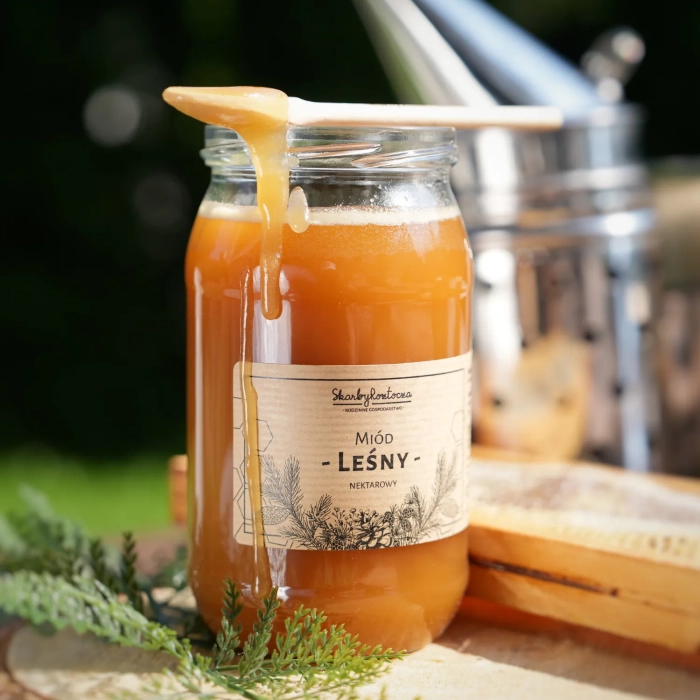
Forest Honey - as the name suggests, forest honey is a product made from plants growing wild in forest areas. Forest honey is made from the nectar of various melliferous plants, such as blackberry, raspberry, blueberry, linden, chamomile and wild rose, and from deciduous or coniferous honeydew. The colour of forest honey depends on the specific harvest, i.e. when and from which flowers the bees collected the nectar. This means that forest honeys from our apiary may be slightly different each harvest and this is by no means a flaw :)
Application of forest honey:
- Has a bactericidal effect.
- Helps in the treatment of skin diseases.
- Increases the immunity and condition of the body.
- It is worth consuming in case of heart diseases and problems with the circulatory system.
- Can be used as sugar in everyday use.
Colour: In liquid form, it can be light or dark amber, whereas over time forest honey pales. After crystallisation, it becomes slightly golden, it can also be greyish-yellow.
Flavour: Sweet, somewhat resinous taste, fragrant herbs can also be sensed in it.
Aroma: Intense scent, and its aroma brings to mind forest clearings.
Storage: Dry and shaded place (temp. 8-18 C)
Flowering time: June/ September
Crystallisation: Medium crystallisation
-
Linden Honey is considered by many connoisseurs to be the best tasting honey. This results from its rich content. This honey is difficult to produce and at the same time rich in ingredients that comprehensively improve our health. It comes from the pollen of linden flowers, which can be difficult to find, as larger clusters of these trees are rare. Therefore, this honey is extremely valuable. Its uniqueness, as well as unusual properties, are highlighted by the linden nectar. Linden honey, similar to the linden flower infusion itself, has medicinal properties.
Application of linden honey:
- Has antiseptic, antispasmodic, diaphoretic, antipyretic, expectorant, mildly hypnotic and sedative effects, lowers fever.
- Helps in treating flu, colds, coughs, acute and chronic cold diseases, angina, inflammation of the paranasal sinuses, and respiratory tract.
- It is recommended for urinary tract diseases and neuroses.
- It is characterised by high antibiotic activity.
Colour: From greenish-yellow to yellow-golden.
Flavour: Sweet, slightly sharp, bitterish
Aroma: Close to the linden flower.
Storage: Dry and shaded place (temp. 8-18 C)
Flowering time: June / July
Crystallisation: Medium crystallisation
-
Rapeseed Honey is one of the most popular honeys in Poland. Polish rapeseed honey is one of the earliest produced honeys; bees collect nectar from rapeseed flowers in the spring period. It is a unique type of honey because it is actually one of the first to be created in the apiary after the winter break. As the name suggests, this golden elixir is made from nectar and pollen collected from rapeseed flowers. Rapeseed is one of the most important crops in Poland.
Application of Rapeseed Honey:
- Helpful in treating the liver, pancreas, kidneys, digestive system, stomach and duodenal ulcers.
- Recommended for treating cardiovascular diseases, heart failure, angina pectoris and atherosclerosis.
- Lowers blood pressure and balances potassium deficiencies in the body.
- Also effective for colds and inflammations of the respiratory tract.
- Accelerates wound healing.
- In the case of burns, it prevents the formation of blisters.
Colour: In liquid state, it is almost colourless or has a slightly straw-like colour; after crystallisation, it has a creamy consistency and white or grey-cream colour.
Smak: Very sweet.
Aroma: Delicate scent.
Storage: Dry and shaded place (temp. 8-18 C)
Flowering time: May
Crystallisation: Very fast.
-
Goldenrod Honey is definitely harder to obtain than other types of honey, partly because the beekeeper must leave some of it as food for the bees for the winter. Goldenrod blooms most intensively when the bees begin winter preparations. The beekeeper must therefore take care of late feeding of the bees to obtain goldenrod honey.
Application of goldenrod honey:
- Helpful in urinary tract infections, as well as respiratory ones.
- Strengthens blood vessels.
- Prevents heart disease.
Colour: From tea-like to amber.
Flavour: Quite a sweet taste. A delicate acidic note can be sensed in it. The taste qualities of this type of honey are also determined by a mild note of bitterness.
Aroma: Acidic floral aromas, but also a herbal note
Storage: Dry and shaded place (temp. 8-18 C)
Flowering time: August/ September
Crystallisation: Quite fast (within a few weeks)
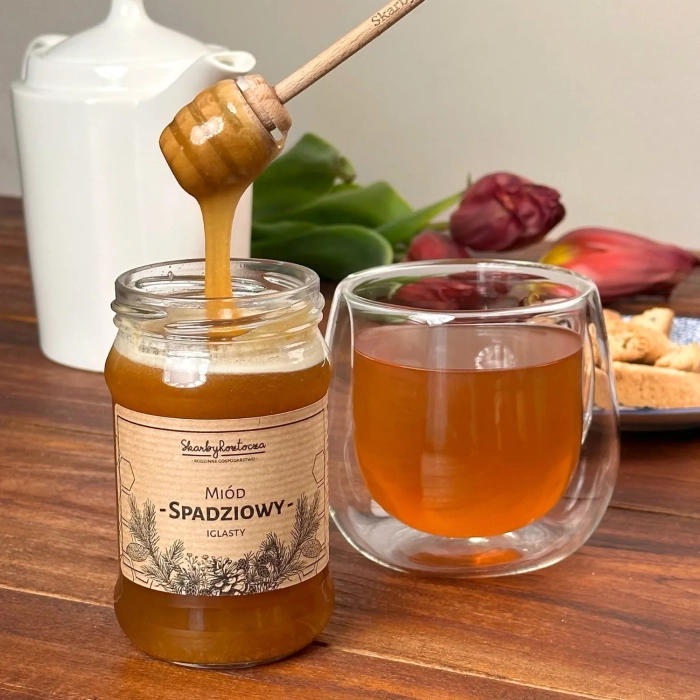
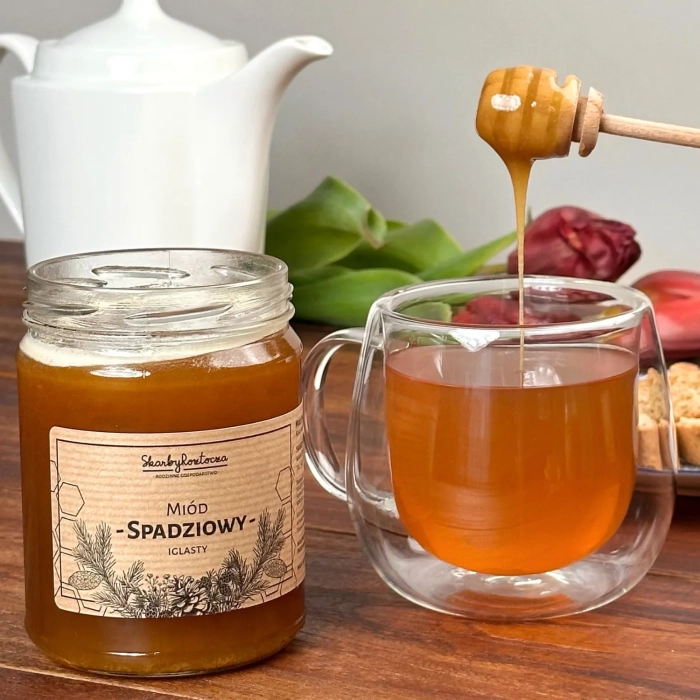
Coniferous Honeydew Honey derived from the honeydew of coniferous trees is a highly valued honey. One of the most expensive on the Polish honey market. It is mostly obtained in areas rich in fir forests. However, other conifers can also produce honeydew – i.e. pine, larch, spruce, and also thuja. Insects take plant sap from the leaves and branches of the listed trees, from which they use protein components, and the remaining sweet, sticky liquid consisting mainly of carbohydrates is called honeydew. These honeys are thicker than nectar honeys and contain more mineral compounds, especially potassium, phosphorus, chlorine, sulphur, calcium, magnesium and iron.
Application of Honeydew Honey:
- Strengthens the heart and circulatory system.
- It is characterised by high antibiotic and bactericidal activity.
- They have antiseptic, anti-inflammatory and expectorant effects, supporting the human immune system.
- Has anti-rheumatic properties.
- They are recommended in diseases of the respiratory tract, digestive tract, heart, circulatory system, nervous system, and in digestive disorders.
Colour: Dark. It takes on colours from dull green through grey-brown to almost black.
Flavour: Intense taste, slightly resinous and not very sweet. Sour or bitterish notes may also occur in it.
Aroma: Delicate, subtly spicy, sometimes also resinous or nutty.
Storage: Dry and shaded place (temp. 8-18 C)
Flowering time: From May to July or from August to October.
Crystallisation: Long crystallisation .