
Which honey to choose? Types of honey
You probably often wonder which honey will be best for us? Which honey to choose?
On the Polish market there are many types of honey, which is why we decided to present the most popular types of honey produced in Poland- from local nectar sources. Fertile soils, a good climate and the high biodiversity of our country enable the production of many different types of honey, each of which can be characterised by specific physicochemical properties.
We hope that thanks to this guide and comparison, you will be able to choose the type of honey best suited to your needs. Both in terms of taste, consistency, crystallisation rate, and health-promoting properties.
Table of contents:
1. Dandelion Honey
2. Maple Honey
3. Blueberry Honey
4. Rapeseed Honey
5. Multifloral Honey
6. Phacelia Honey
7. Acacia Honey
8. Raspberry Honey
9. Bean Honey
10. Forest Honey
11. Linden Honey
12. Goldenrod Honey
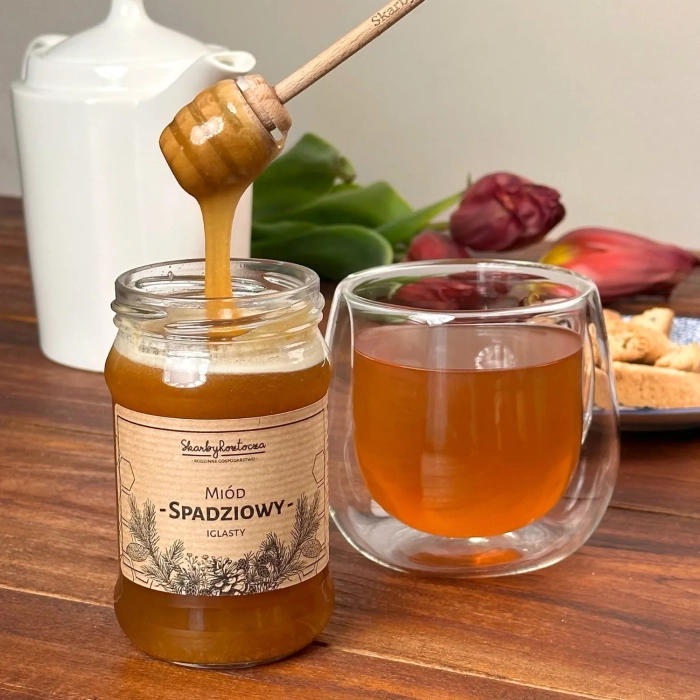
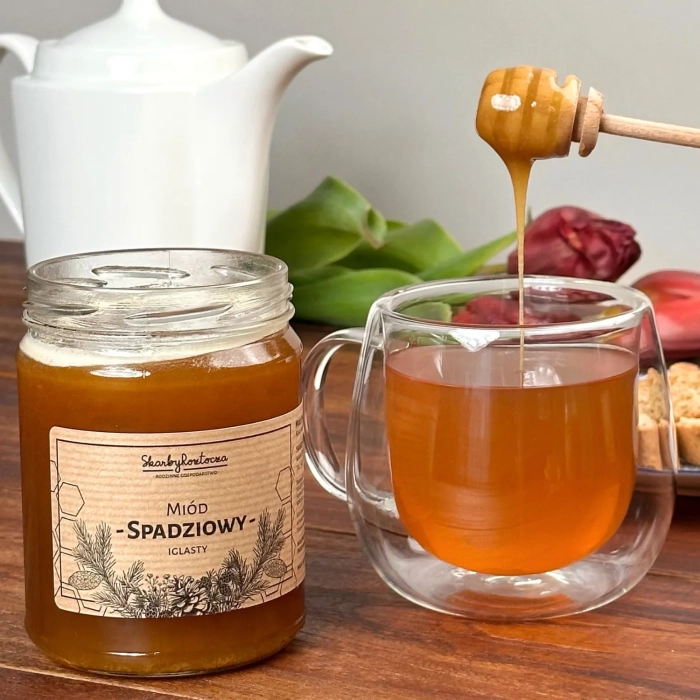
13. Honeydew Honey
1. Dandelion Honey
Dandelion Honey, as the name suggests, is obtained from common dandelion. Despite the great popularity of dandelion flowers, dandelion honey is very difficult to obtain. It is also called May honey because that is when the dandelion blooms abundantly.
Uses of dandelion honey:
- Used for problems with the liver, stomach and kidneys, as well as in states of reduced immunity.
- Supports the digestive system.
- It is also used for heart and gallbladder diseases, kidney and bladder issues, rheumatic ailments and urinary tract diseases.
Colour: From creamy through light yellow to intense orange. Most commonly found in a light yellow shade
Taste: Very sweet, slightly bland. It is considered one of the sweetest varietal honeys in Poland.
Aroma: Noticeable aroma of dandelion flowers.
Storage: Dry and shaded place (temp. 8-18 C)
Flowering time: May
Crystallisation: Quite quickly (within a few weeks) and unevenly, into fine, spreadable crystals.
2. Maple Honey
Maple Honey due to its protein content, fatty acids, vitamins B1, B2, C, as well as potassium and iron, has the power of a true medicine. It has a haematopoietic effect and at the same time purifies the blood. Maple honey is easily digestible, and in addition, it is a significant source of strengthening for the organism and immunity. It is responsible for the increase of energy and vitality. Thanks to this, maple honey is the ideal honey for people struggling with the flu. Maple honey has a slightly caramel taste, and due to its high fructose content, it is recommended for children.
Uses of maple honey:
- Has a haematopoietic effect-purifies the blood.
- Source of strengthening and immunity for the body.
- Ideal honey for people struggling with the flu.
- Recommended for children.
Colour: Dark brown in liquid form, light cream in crystallised form
Taste: Sweet, mild, similar to the taste of maple syrup Aroma: Reminiscent of the scent of maple syrup
Storage: Dry and shaded place (temp. 8-18 deg. C)
Flowering time: April / May
Crystallisation: Fast crystallisation
3. Blueberry Honey
Blueberry Honey is a unique honey collected from highbush blueberry plantations. Considered by many to be the tastiest nectar honey. The highbush blueberry is a relative of the wild bilberry. Its dark blue fruits are valued worldwide not only for their taste, but also because of their exceptionally beneficial effect on the body- which is why we place our hives directly on blueberry plantations to benefit from the properties of the blueberry.
Uses of blueberry honey:
- Protects against cancer.
- Improves eyesight.
- Has detoxifying properties- cleansing our body.
- Effective in fighting heart disease.
Colour: Reminiscent of the colour of brewed tea.
Taste: Deeply sweet taste, with an aroma slightly reminiscent of blueberries. Aroma: Reminiscent of the scent of highbush blueberries.
Storage: Dry and shaded place (temp. 8-18 C)
Flowering time: May
Crystallisation: Fast crystallisation
4. Rapeseed Honey
Rapeseed Honey is one of the most popular honeys in Poland. Polish rapeseed honey is one of the earliest produced honeys, as bees collect nectar from rapeseed flowers in the spring. It is a unique type of honey because it is essentially one of the first to be created in the apiary after the winter break. As the name suggests, rapeseed honey is made from nectar and pollen collected from rapeseed flowers. Rapeseed is one of the most important crops in Poland.
Uses of Rapeseed Honey:
- Helpful in treating the liver, pancreas, kidneys, digestive system, and gastric and duodenal ulcers.
- Recommended for treating cardiovascular diseases, heart failure, angina pectoris and atherosclerosis.
- Lowers blood pressure and compensates for potassium deficiencies in the body.
- Also effective for colds and inflammation of the respiratory tract.
- Accelerates wound healing.
- In case of burns, it prevents the formation of blisters.
Colour: In liquid state, it is almost colourless or has a light straw colour; after crystallisation, it has a creamy consistency and a white or grey-cream colour.
Taste: Very sweet.
Aroma: Delicate scent.
Storage: Dry and shaded place (temp. 8-18 C)
Flowering time: May
Crystallisation: Very fast.
5. Multifloral Honey
Multifloral honeys are a large group of honeys that are among the most popular and commonly used bee products. Multifloral honeys differ in taste, colour and health benefits. These properties depend on the species of flowers, shrubs and trees chosen by the bees, the location of the apiaries and the harvest dates.
Uses of multifloral honey:
- Thanks to easily absorbable simple sugars, it supports the heart muscle.
- Helpful for liver and gallbladder diseases.
- Helps people allergic to pollen to tolerate and build immunity against allergies.
- Due to its mild taste, multifloral honey is recommended for children when treating flu, colds, lower respiratory tract diseases, and also preventively.
Colour: Varying colour, from light cream to tea-coloured; after crystallisation, light grey or light brown
Taste: Mild and sweet
Aroma: Pleasant and delicate floral scent
Storage: Dry and shaded place (temp. 8-18 C)
Flowering time: The entire spring/summer period
Crystallisation: Medium crystallisation
6. Phacelia Honey
Phacelia honey is classified as a nectar honey and is obtained precisely from phacelia flowers. This plant has many varieties, however, in Poland, the most common is lacy phacelia, distinguished by its beautiful, blue-purple (sometimes light blue) colour. Fields overgrown with this flower species look absolutely amazing and you can almost always find diligently working bees on them. It is not without reason that they spend many hours in such places, as phacelia is considered one of the most melliferous plants – beekeepers often call it the "queen of melliferous plants". Phacelia Honey due to its precious properties is increasingly often called the Polish Manuka honey (Onet).
Uses of phacelia honey:
- Particularly during a cold and when we feel like we are "coming down with something".
- Has antibacterial and protective effects.
- Reduces the toxic effects of nicotine, alcohol, as well as tea and coffee.
- Supports the treatment of digestive system diseases.
Colour: Light or dark depending on the soil
Taste: Subtle, slightly acidic (although this is not very noticeable)
Aroma: Flower aroma
Storage: Dry and shaded place (temp. 8-18 C)
Flowering time: From May to August
Crystallisation: Medium crystallisation, from several weeks to several months.
7. Acacia Honey
Acacia honey is one of the few types of honey that has a very light colour. It is most often described as light straw-coloured. Patoka, the liquid form of honey, sometimes has such a light colour that it seems to be even colourless. It is obtained during the flowering period of the black locust, which is an excellent melliferous material for bees. Acacia honey is a valuable source of substances beneficial for the human body.
Uses of acacia honey:
- Recommended for consumption by diabetics.
- Recommended in cases of intestinal and stomach cramps.
- It soothes the symptoms of hyperacidity.
- It is recommended in the fight against insomnia.
- A very good and useful remedy for coughs, as well as in cases of colds.
- Exhibits a diuretic effect, combined with the simultaneous cleansing of the urinary system.
Colour: Light straw, colourless
Taste: Sweet, delicate, slightly bland, slightly acidic.
Aroma: Weak, close to the scent of acacia flowers.
Storage: Dry and shaded place (temp. 8-18 C)
Flowering time: May/June
Crystallisation: Very weak and slow.
8. Raspberry Honey
Raspberry Honey- its uniqueness lies in the fact that, as the name suggests, it is made from raspberry flowers, and these bloom for only three weeks, about twice a year. We do not add any juices or syrups to our honeys- everything is the result of only our bees' actions. Bees love to collect pollen from every variety of raspberry. This is because raspberry flowers provide them with plenty of nectar and contain a lot of sugar. It should be noted that the production of raspberry honey is also dependent on the location of the apiary. Which must be located near raspberry bushes so that this delicious elixir is created only from raspberry flowers. In Poland, the largest raspberry crops are found in the Lublin region and in our title Roztocze :)
Uses of raspberry honey:
- Recommended during colds and in diseases of the upper respiratory tract.
- Strengthens immunity.
- Also supports the work of the heart muscle.
- Has a warming, antipyretic and diaphoretic effect.
- Recommended for people who work hard physically or mentally.
Colour: Yellow, but dependent on the raspberry species.
Taste: Sweet, mild, pleasant, slightly sour.
Aroma: Reminiscent of the scent of raspberry flowers.
Storage: Dry and shaded place (temp. 8-18 C)
Flowering time: May/August
Crystallisation: Fast crystallisation
9. Bean Honey
Bean Honey is a product entered on the list of traditional products, characteristic of the Roztocze region. It has a strong aroma derived from bean flowers. It is not very sweet and slightly acidic. Interestingly, Roztocze is one of the least cloudy and most sunny areas of Poland during the summer period, and it is thanks to this that the local climatic conditions are perfectly suited for growing beans and producing bean honey.
Uses of bean honey:
- Strengthens the immune system.
- Supports heart function.
- Facilitates the treatment of flu and colds.
- Soothes gastrointestinal ailments.
- Accelerates the restoration of microorganisms necessary for proper digestion.
Colour: In liquid form, it is straw-coloured, and when it crystallises, it becomes creamy white.
Taste: Not very sweet, and even slightly acidic.
Aroma: Aroma of bean flowers.
Storage: Dry and shaded place (temp. 8-18 C)
Flowering time: June/July
Crystallisation: Medium crystallisation.
10. Forest Honey
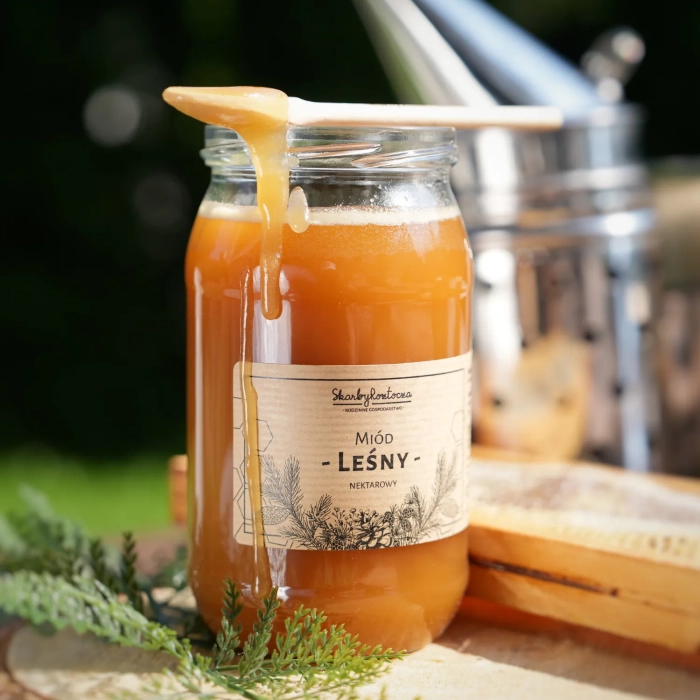
Forest Honey - as the name suggests, forest honey is a product made from plants growing wild in forest areas. Forest honey is made from the nectar of various melliferous plants, such as blackberry, raspberry, blueberry, linden, chamomile and wild rose, as well as from deciduous or coniferous honeydew. The colour of forest honey depends on the given harvest, i.e., when and from which flowers the bees collected the nectar. This means that forest honeys from our apiary may be slightly different with each harvest and this is by no means their defect :)
Uses of forest honey:
- Has a bactericidal effect.
- Helps in the treatment of skin diseases.
- Increases the immunity and condition of the body.
- It is worth consuming in the case of heart disease and problems with the circulatory system.
- It can be used as sugar in everyday use.
Colour: In liquid form it can be light or dark amber, whereas over time forest honey pales. After crystallisation, it becomes slightly golden, it can also be grey-yellow.
Taste: Sweet, somewhat resinous taste, fragrant herbs can also be sensed in it. Aroma: Intense scent, and its aroma brings to mind forest glades.
Storage: Dry and shaded place (temp. 8-18 C)
Flowering time: June/September
Crystallisation: Medium crystallisation
11. Linden Honey
Linden Honey is considered by many connoisseurs to be the best-tasting honey. This results from its rich content. Linden honey is difficult to produce and at the same time rich in ingredients that comprehensively improve our health. It comes from the pollen of linden flowers, which can be hard to find as larger clusters of these trees are rare. Therefore, this honey is extremely valuable. Its uniqueness, as well as its extraordinary properties, are emphasized by the nectar from the linden tree. Linden honey, just like the infusion of linden flowers itself, has medicinal properties.
Uses of linden honey:
- Has antiseptic, antispasmodic, diaphoretic, antipyretic, expectorant, slightly hypnotic and sedative effects; it lowers fever.
- Helps in the treatment of flu, colds, coughs, acute and chronic chill-related illnesses, angina, sinusitis, and respiratory tract infections.
- It is recommended for urinary tract diseases and neuroses.
- It is characterised by high antibiotic activity.
Colour: From greenish-yellow to yellow-golden.
Taste: Sweet, slightly sharp, bitterish
Aroma: Similar to linden flower.
Storage: Dry and shaded place (temp. 8-18 C)
Flowering time: June / July
Crystallisation: Medium crystallisation
12. Goldenrod Honey
Goldenrod Honey is definitely more difficult to obtain than other types of honey, among other things because the beekeeper must leave a certain part of it as food for the bees for the winter. Goldenrod blooms most intensively at the time when bees begin winter preparations. The beekeeper must therefore ensure late feeding of the bees if they want to obtain goldenrod honey.
Uses of goldenrod honey:
- Helpful in urinary tract infections, as well as respiratory infections.
- Strengthens blood vessels.
- Prevents heart disease.
Colour: From tea to amber.
Taste: Quite a sweet taste. A delicate acidic note can be sensed in it. A mild note of bitterness also determines the flavour values of this type of honey. Aroma: Acidic flower aromas, but also a herbal note Storage: Dry and shaded place (temp. 8-18 C)
Flowering time: August/September
Crystallisation: Quite fast (within a few weeks)
13. Honeydew Honey
Honeydew Honey coming from the honeydew of coniferous and deciduous trees is a very valued honey. Honeydew honey is one of the most expensive honeys on the Polish market. Especially when it comes to coniferous honeydew honey. Honeydew honey is so different from nectar honey that it attracts people who normally do not love honey. Its aromatic complexity evokes delight
Honeydew honey - how and where is it made?
To better understand what honeydew honey is, we must know that bees can produce honey by collecting and processing two different nutrients: nectar and honeydew. However, honeydew, unlike nectar, is not produced directly from plants, but from insects that take sap from plants to live and reproduce, secreting a product still rich in nutrients, especially sugars: honeydew. Drops of honeydew stick to leaves, branches, bark and so on; bees find it, collect it and thanks to their work, produce honey.
Honey from coniferous honeydew and deciduous
Honey from coniferous honeydew and deciduous is a honey thicker than nectar honey and contains more mineral compounds, especially potassium, phosphorus, chlorine, sulphur, calcium, magnesium and iron. From an organoleptic point of view, honey from coniferous and deciduous honeydew is less sweet, and the colour is darker than nectar honey and remains liquid for a long time. One of the nectar honeys that perhaps most resembles honeydew honey is chestnut honey (not very popular in Poland).
Uses of honeydew honey:
- It is characterised by high antibiotic and bactericidal activity.
- It has antiseptic, anti-inflammatory and expectorant effects, supporting the human immune system.
- Honeydew honey on a daily basis strengthens the heart and cardiovascular system.
- It has anti-rheumatic properties.
- It is recommended for respiratory tract, digestive tract, heart, cardiovascular, and nervous system diseases, and for digestive disorders.
Honeydew Honey properties:
Colour: Dark. It takes on colours from rotten green through grey-brown to almost black.
Taste: Intense taste, slightly resinous and not very sweet. Sour or bitter notes can also occur in it.
Aroma: Delicate, subtly spicy, sometimes also resinous or nutty.
Storage: Dry and shaded place (temp. 8-18 C)
Flowering time: From May to July or from August to October.
Crystallisation: Long crystallisation.
Now you know which honey to choose!
We hope that this extensive presentation of all honeys occurring in Poland will help you in making the right decision which honey to choose. It is worth choosing honeys because of their health properties or simply our personal taste preferences.
We remind you that all the discussed types of honey, can be found in our online store under the link: https://www.skarbyroztocza.mom/miody-z-pasieki
If you have any questions for us, or further doubts regarding the choice of the best honey, we encourage you to contact us: Contact telephone number: +48 660850764
Contact e-mail: info@skarbyroztocza.mom
We invite you to join the fight for healthy eating habits not only for ourselves, but also for our loved ones :)