
What are honey blooms and how to deal with them?
If you are a honey lover, you may have encountered a situation where strange crystals or spots appeared on its surface. These undesirable changes are called honey blooms.
Today, we will take a closer look at this phenomenon and discuss what you can do when you notice them in your favourite product.
Table of contents:
- What are blooms in honey?
- Why do blooms form?
- Are blooms safe to eat?
- How to deal with blooms?
- Summary.

1. What are honey blooms?
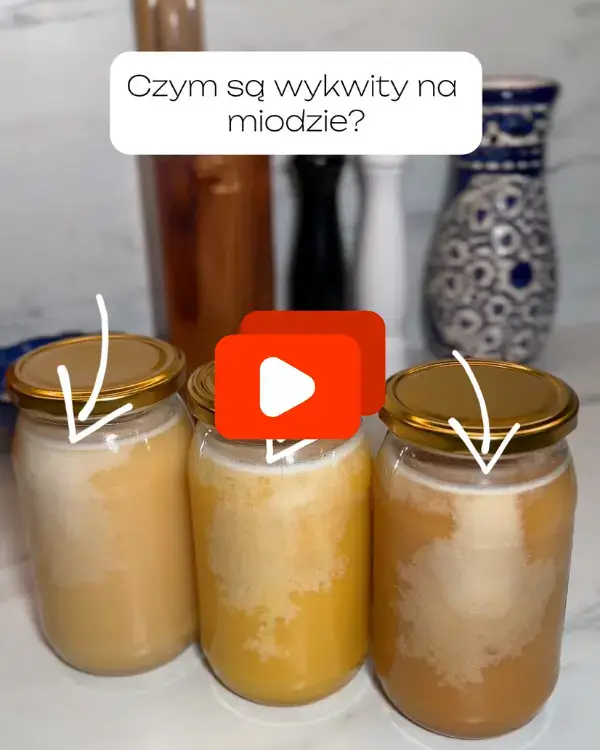
Blooms are visible white coatings on honey that can take various shapes. Blooms indicate the very high quality of the product, its biological activity, and the fact that the honey has never been overheated. They are most commonly found in high-glucose honeys and are also clearly visible on dark honey varieties such as buckwheat honey.
2. Why do blooms form?
Blooms are often associated with trapped air bubbles that were caught in the honey poured into jars, which-during the transition of the honey from a liquid to a crystallised state-did not have time to escape before crystallisation.
Blooms also form as a result of the presence of yeasts naturally occurring in honey. In every nectar, the presence of yeasts can be found, which are carried by bees from the air to the hive. To nectars containing a lot of sucrose, bees add many enzymes, and with them many inhibins, which destroy the yeasts. To nectars containing no sucrose or very little of it, bees add few enzymes and inhibins, which the yeasts take advantage of by having a nutrient medium in the honey.
This is why in high-glucose honeys, you can notice white blooms forming on the surface of the honey and along the sides of the container it is in, which enlarge over time. This is proof that the yeasts are feeding, consuming fructose, and leaving behind a type of glucose foam. This is also proof that the honey is alive, has not been subjected to unnecessary thermal processing, and is still biologically active.
The occurrence of blooms on honey is a natural phenomenon and a kind of confirmation of the high quality of the bee product and its rawness, so they are completely safe to consume and will not affect its quality or nutritional value. However, they may change the appearance and texture of the honey.
Sometimes, however, an excessive amount of white coating, as well as the aeration of the honey, may be a sign of the beginning of fermentation processes - if you notice worrying changes, such as an unpleasant smell or a strange sour taste, do not consume the honey and report the problem with the product to the beekeeper.
4. How to deal with blooms?
Although it is not a product defect, people who do not want to have the changes described above in their honey can use the following methods:
1. Gently heating the honey in a water bath can also help dissolve the blooms and restore a liquid consistency.
2. Remove the excess bloom with a spoon.
By maintaining proper storage conditions for honey, i.e. storing it in a cool and shaded place, you favour the crystallisation process and thus the progressive changes such as blooms. We encourage you to follow the recommendations on the label and ensure proper storage conditions for our bee treasures, thereby protecting them against unfavourable changes in honey such as fermentation.
Blooms on honey are a natural phenomenon that can sometimes occur - especially in raw and high-glucose honeys, and they are also more visible on darker types of honey. Blooms do not affect the taste or nutritional value of the honey, and are even a kind of confirmation of the quality of the bee product and its living structure and biological activity.
If you have any doubts about the changes occurring in the honey, you can always consult a beekeeper to verify if everything is fine with the product.
P.S. Do you like content in the form of videos? See our video on what honey blooms are.