

WHAT COLOURS DO BEES SEE?
Wondering how a bee sees? What colours it recognises? What colours it likes and why beehives are painted?
We will try to answer these questions in this blog.
Enjoy the read! 🙂
Table of contents:
1. Structure of the bee eye
2. Colours seen by bees
3. Bees' favourite colours
4. Summary and conclusions
1. Structure of the bee eye.
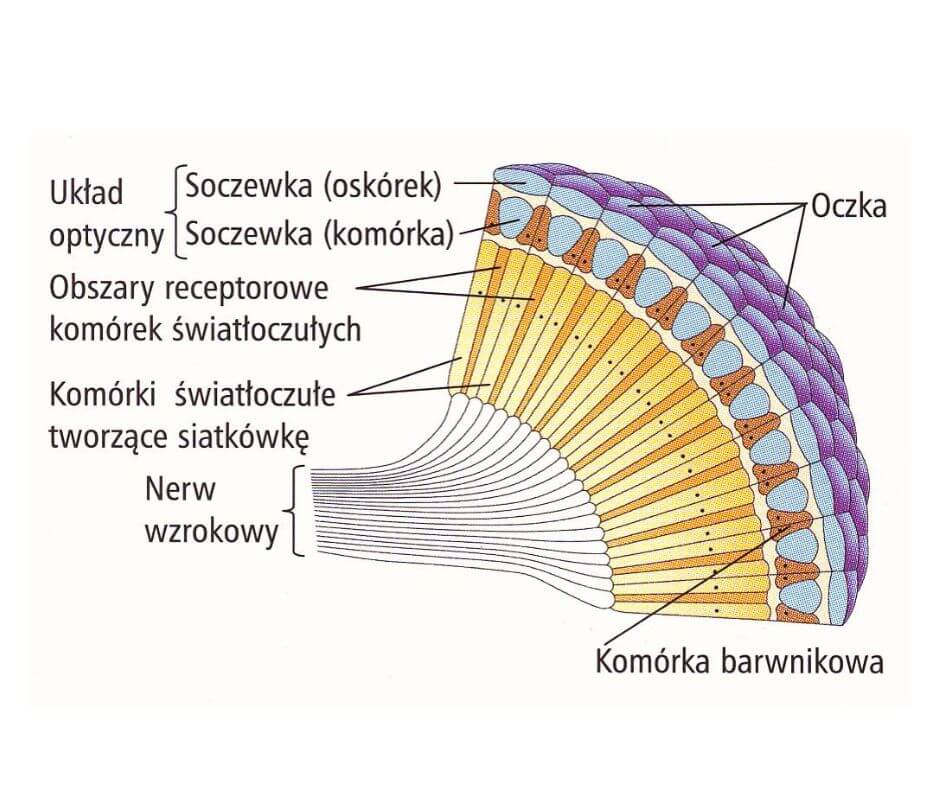
The bee's organ of sight consists of 2 types of eyes - compound eyes made up of many smaller eyes (so-called facets) and 3 pairs of simple eyes, the so-called ocelli. Compound eyes are hexagonal in shape and form a coherent mosaic structure consisting of several thousand smaller eyes. They are placed on the sides of the head as 2 distinct pairs of “black eyes” and are designed to collect images from the surroundings and successively process the collected “mosaic” into a coherent image perceived by the insect. Additional ocelli are located between the compound eyes on the top of the head and are used to detect light intensity, which helps the bee determine the time of day, navigate in a dark hive, or find its way home after dark.
2. Colours seen by bees.
Despite having such a complex visual apparatus, the bee only sees a few colours. Colours well perceived by bees are white, black, yellow and blue, as well as violet and ultraviolet, which is invisible to us. However, a bee does not recognise the colour red and also has trouble distinguishing between green and orange - it identifies these colours by their degree of saturation and also does not recognise shades of colours and likes saturated colours.
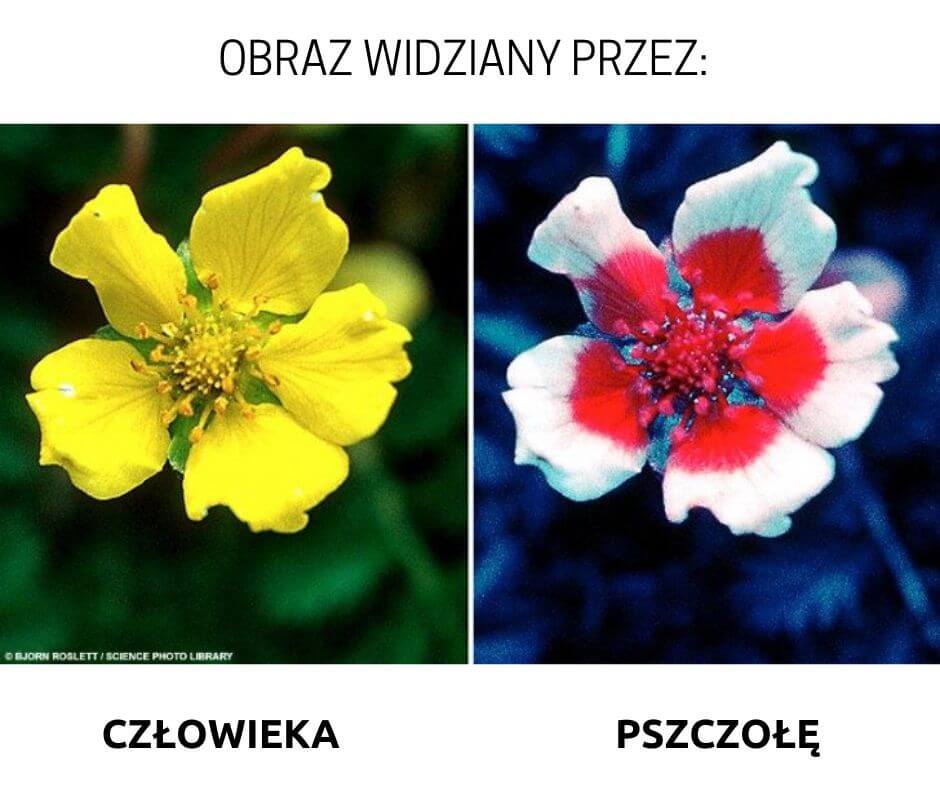
The favourite colours of our winged friends will indeed be those they distinguish perfectly, namely blue, yellow, white and black. Subconsciously, however, they will be most drawn to blue, because their experience shows that flowers of this colour are the richest in the sweet nectar they love.
It is also known that no colours deter bees. It is therefore impossible, by means of appropriate clothing, to ensure that flower nectar enthusiasts do not hang around us at all.
Since we are on the subject of flower colours and bees, it is worth mentioning that our flora has also adapted to bees' colour preferences, which is why there are many yellow, white or blue flowers in nature, while red inflorescences occur much less frequently. Everything, of course, depends on what colours bees see and other winged insects.
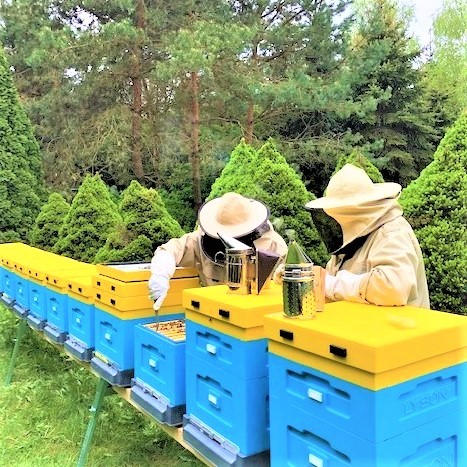
Possessing this knowledge of how bees perceive the world, many beekeepers and hive manufacturers choose the above colours in their apiaries so that they are clearly visible to the industrious insects and help them return to their hive. Unpainted wooden hives, or those in green or red colours, may be invisible to bees, blending into the background of nature that surrounds them, and may cause difficulties in finding them. This is particularly important during the mating flight of a young queen bee, as well as lost bees may mistakenly fly into other hives and spread potential pathogens between colonies in the apiary. See a photo of the hives from our apiary:
Bibliography/Sources:
1. Antoni Demianowicz, Bees, Their Life and Breeding, Rodzina Kolejowa, Warsaw 1936, preface
2. Jerzy Wilde, Jarosław Prabucki (eds.), Bee Breeding, Powszechne Wydawnictwo Rolnicze i Leśne, Warsaw 2009, pp. 59-76
3. Zbigniew Lipiński, Honey Bee Nutrition, Wielbark 2014, p. 65
4. Zbigniew Lipiński, Honey Bee Nutrition, Wielbark 2014, p. 76
5. Jerzy Wilde (ed.), Beekeeping Encyclopedia, Powszechne Wydawnictwo Rolnicze i Leśne, Warsaw 2013, p. 335
6. 1. Bunalski M., Piekarska-Boniecka H., Wilkaniec B. Entomology. General Entomology part 1. Państwowe Wydawnictwo Rolnicze i Leśne, 2009.
7. Horridge A. What does an insect see? "Journal Of Experimental Biology" (2009) 212 (17): 2721–2729. https://journals.biologists.com/jeb/article/212/17/2721/18539/What-does-an-insect-see
8. Comparative photo: Bjorn Roslet - Scenic Photo Library