
What do queen bee marking colours mean?
Queen bee marking colours play a key role in apiary management, making it easier for beekeepers to identify the age of queens and effectively monitor their health and productivity. The marking system is based on an international colour code that operates in five-year cycles. Each colour corresponds to a specific year, allowing for an easy determination of how long a given queen has been in the hive.
Are you interested in what queen bee marking colours mean? We invite you to read our post!
Table of contents:
1. The queen bee marking colour system
2. The importance of colours in beekeeping practice
3. Marking queens – how is it done?
4. Educational aspects of colours
1. The queen bee marking colour system
Each colour is assigned to the last digit of the decade.
White – we mark in years 1 and 6 (Queens marked in white are young, meaning they have only recently been in the hive).
Yellow – we mark in years 2 and 7.
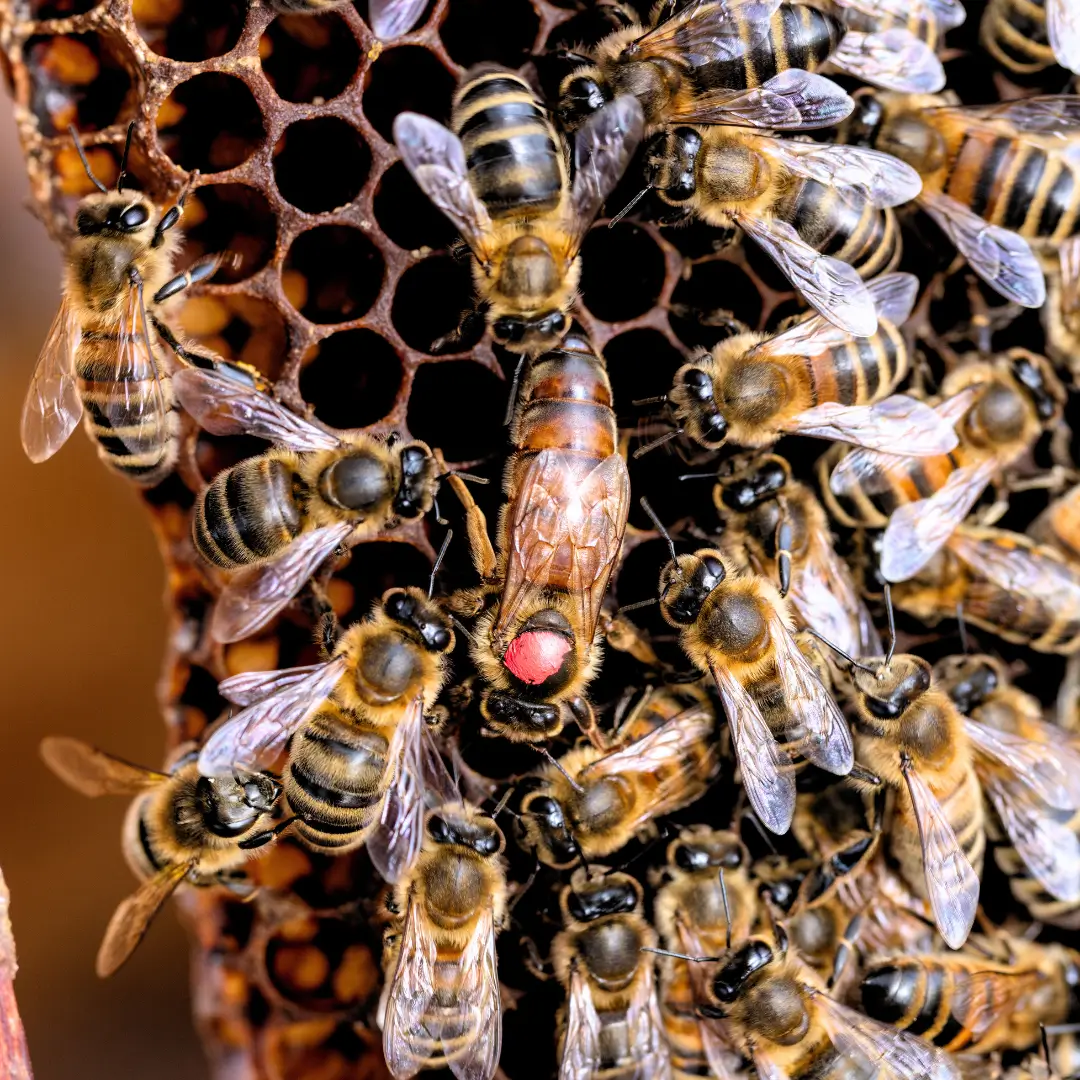
Red – we mark in years 3 and 8 (These queens are already three years old and may show the first signs of declining fertility).
Green – we mark in years 4 and 9 (Queens marked in green are in their fourth year of life, and their productivity may be starting to decline).
Blue – we mark in years 5 and 10 (Queens in their fifth year of life are usually less fertile and more frequently replaced).
2. The importance of colours in beekeeping practice
Queen bee marking colours play a key role in effective apiary management, serving as an indispensable tool in a beekeeper's work. They significantly facilitate the daily maintenance of hives and allow for better monitoring of the health and productivity of the entire bee colony.
Monitoring queen age and hive efficiency - one of the most important aspects of colour marking is the ability to easily monitor the age of the queen bee. The queen bee is the heart of the hive, responsible for laying eggs from which new bees hatch. Her productivity, and consequently her fertility, is crucial for the health and development of the bee colony.
As queen bees age, they become less fertile, meaning they are no longer able to lay as many eggs as in their early years. A reduced amount of brood leads to a weakening of the entire hive, which in turn can affect honey production. Thanks to colour marking, a beekeeper can quickly assess whether a given queen is approaching the age where her replacement will be necessary. Older queens, which may be less productive, are easy to identify thanks to their assigned colour.
Facilitating hive inspections and quality control - marking colours are also extremely useful during regular hive inspections. During such an inspection, when the beekeeper must find the queen among thousands of workers, the intense colour on the queen's thorax makes her much more visible. This not only speeds up the work but also reduces stress for the bees, which are less exposed to accidental damage or prolonged disturbances in the hive.
Finding the queen quickly also allows for ongoing monitoring of her condition. The beekeeper can check if the queen is healthy, if she is still laying eggs intensively, and if she shows no signs of disease or ageing. Regular monitoring of the queen's quality helps maintain balance in the hive, which translates into better results in honey production and the health of the entire bee colony.
Planning queen replacement - colour marking is also helpful in planning queen replacements. By knowing the queen's year of birth (which is easy to recognise by the colour), the beekeeper can plan in advance when to replace the queen with a younger one. Introducing a new, young queen to the hive at the right moment helps avoid problems associated with a sudden drop in the bee population, which could negatively affect the hive's condition and its ability to produce honey.
3. Marking queens – how is it done?
Marking queen bees is a key element of apiary management that requires the right tools, skills, and precision. This process is delicate because the queen bee is the most important member of the bee colony, responsible for laying eggs and maintaining the strength of the hive. Proper marking enables the beekeeper to easily identify the queen and monitor her age, which is essential for effective apiary management.
Markers and paints - special markers for marking queen bees are most commonly used. They are available in five standard colours, corresponding to specific years according to the international marking system. These paints are non-toxic and durable, providing a long-lasting mark that will not harm the queen or the bees in the hive.
Brushes and applicators - special brushes or applicators are used to apply the paint or marker to the queen's thorax. These must be gentle so as not to damage the queen, yet precise so that the marking is clear and durable.
4. Educational aspect of colours
For beginner beekeepers, queen marking colours also have educational value. They help in understanding the life cycle of the queen bee and teach how important it is to regularly monitor her condition. Thanks to the colours, one can quickly acquire knowledge about apiary management, which is key to maintaining healthy and productive bee colonies.
Queen bee marking colours are not just a practical tool, but also a way to better understand hive dynamics and optimise apiary work. Regular marking and monitoring of queens allows for maintaining balance in the hive, which translates into better results in honey production and bee health.
Marking queen bees using colours is not only a practical tool but also a key element of apiary management. The colours correspond to specific years and allow beekeepers to quickly assess the age of the queen, which is important for maintaining a healthy and productive hive. Thanks to proper marking, queens are more easily visible in the hive, which speeds up beekeeping work and enables monitoring of their health and efficiency. Understanding and using the queen marking colour system is therefore essential for anyone who wants to run their apiary with success.