
What is honey crystallisation?
Honey crystallisation is a natural process in which the sugars contained in honey crystallise, leading to a change in its consistency from liquid to solid. It is a common and natural phenomenon. Crystallisation can be evidence of high honey quality.
To find out more about what honey crystallisation is, we invite you to read this short article.
Table of contents:
2. The process of crystallisation.
4. Benefits of crystallisation.
1. Causes of crystallisation.
Honey crystallisation, although it may seem unfamiliar and concerning, is a natural process resulting from its chemical composition and storage conditions. The main causes of this phenomenon are the high concentration of sugars, mainly glucose and fructose, which are the primary components of honey. Glucose is more prone to crystallisation than fructose, so the more glucose honey contains, the greater the likelihood of crystallisation.
Other factors influencing honey crystallisation are storage temperature and time. Lower temperatures favour faster crystallisation, so honey stored in cooler conditions, such as pantries or cellars, is more likely to crystallise.
It is worth noting that crystallisation does not mean that the honey is spoilt or inedible. On the contrary, crystallised honey is still full-value and retains all its nutritional and medicinal properties. Crystallisation extends the shelf life of honey, protecting it from fermentation processes.
2. The process of crystallisation.
The process of honey crystallisation is a natural phenomenon resulting from its chemical composition and storage conditions. The main factor that determines crystallisation is the high concentration of sugars, mainly glucose and fructose, in honey.
The crystallisation process usually starts gradually. A small amount of glucose in the honey begins to form crystals, which change into a solid state. Crystallisation often starts from the edge of the jar or from places where there may be pollen particles, wax residues, or other particles that act as the main crystallisation factor.
Honey crystallisation can take various forms depending on its variety and chemical composition. Some honeys crystallise more finely, creating a smooth, uniform consistency, while others may form larger crystals that are more noticeable when consumed.
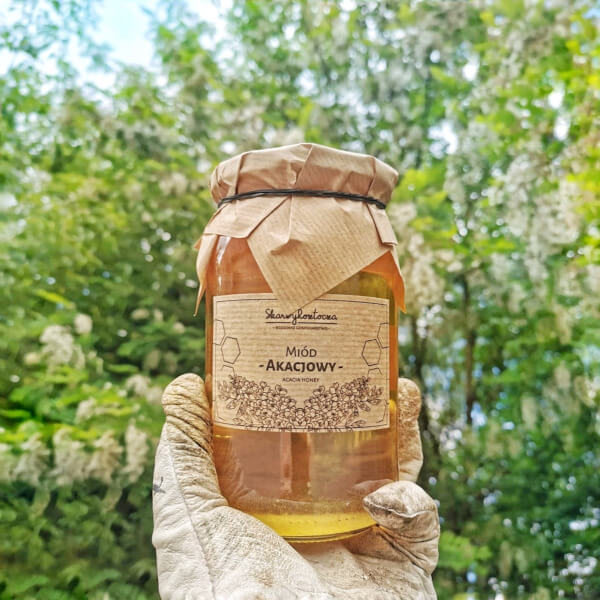
The slowest crystallising honey is Acacia Honey.
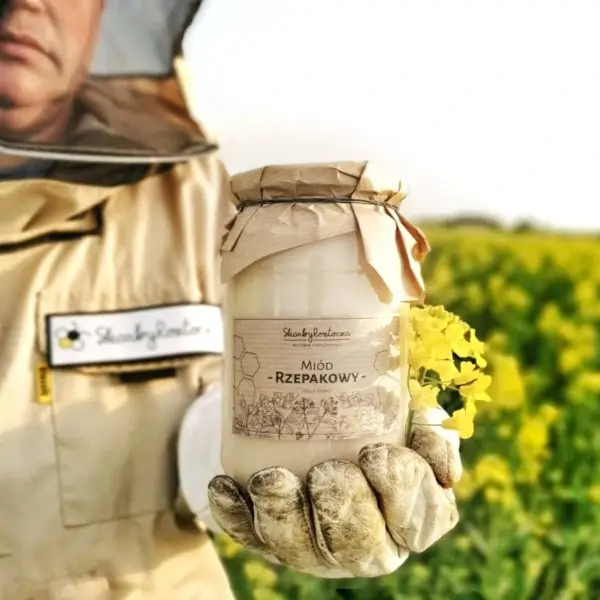
The fastest crystallising honey is Rapeseed Honey - sometimes it crystallises even in the hive.
3. Types of crystals.
The types of crystals that form during honey crystallisation determine its final texture and consistency. This process can lead to the formation of different types of crystals that affect the final structure of the product.
- Fine crystals
Honeys that crystallise in the form of fine crystals usually have a delicate, uniform texture.
These honeys are often creamy and easy to spread, making them popular for use as additions to tea, spreading on bread, or adding to various culinary dishes.
- Coarser crystals
Some honeys may crystallise in the form of larger crystals.
Such honeys have a harder, brittle consistency, making them more visible during consumption.
Honeys with coarser crystals are often preferred by people who like the perceptible structure of crystals in honey.
- Mixed crystals
Sometimes honey can crystallise in a mixed way, containing both fine and larger crystals.
Such honey has a varied texture that can combine the advantages of both soft, creamy honey and harder, more brittle honey.
The crystallisation process depends on the chemical composition of the honey and storage conditions. Larger amounts of fructose in honey usually favour the formation of fine crystals, while a higher concentration of glucose can lead to the formation of larger crystals.
It is important to understand that honey crystallisation is a natural process and does not mean that the product is spoilt or not tasty. Crystallised honey retains all its nutritional and medicinal properties, and its consistency can be easily restored by gently heating it in warm water. Knowing the different types of honey crystals allows one to appreciate its diversity and adapt its use to one's own culinary and practical preferences.
4. Benefits of crystallisation.
Crystallisation has many benefits, and these are some of them:
- Preservation of nutritional value
Crystallised honey retains all its natural nutrients, such as enzymes, vitamins, minerals, and antioxidants. The process of crystallisation does not cause the loss of these valuable substances, so the honey remains a full-value health product.
- Better durability
Crystallised honey tends to store longer compared to its liquid form. Crystallisation acts as natural preservation, helping to protect the honey from the growth of microorganisms and fermentation. As a result, it can be stored for a longer period without fear of quality loss.
- Variety of textures
The crystallisation process can lead to different textures of honey, from delicate, creamy crystals to more compact, brittle forms. This makes crystallised honey an interesting and diverse taste and visual experience for consumers.
- Naturalness and authenticity
Crystallised honey is proof that it is a natural product, not subjected to intensive processing. It is precisely the crystallisation process that testifies to its authenticity and the absence of chemical additives or modifications.
5. Summary.
Honey crystallisation is a natural process that testifies to the high quality of honey and has no impact on its nutritional value or health properties. You can easily restore the honey's liquid consistency by gently heating it, which allows you to enjoy its taste and health benefits for a long time.