
WHITE BLOOM ON HONEY
Where does it come from? Is the honey good or has it spoiled or fermented?
Extracting honey from the comb requires subjecting it to the centrifugal force generated by a honey extractor, which is a device where frames taken from the hive are placed. In this process, the honey becomes heavily aerated. The honey flows down the walls of the extractor and exits through its bottom opening, where it passes directly through a fine mesh strainer into a settling tank, from which the honey is then bottled into jars.
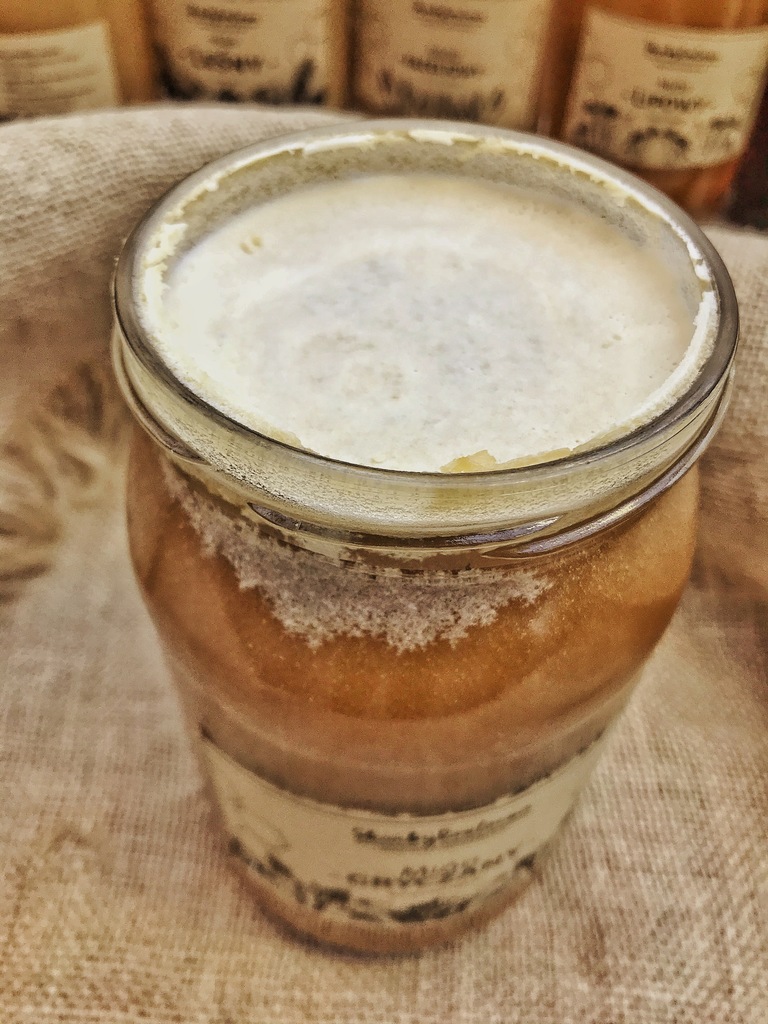
Air bubbles trapped in the bottled honey try to escape upwards, but not all the air manages to reach the surface because honey in its liquid phase is a very dense liquid. In this way, the air trapped in the honey creates a discoloration or streak effect during crystallization, i.e., the transition from a liquid state to a granulated state. This is particularly visible in dark and quickly crystallizing honeys, where glucose predominates. Such discolorations are called efflorescences, which take on various abstract shapes.

WHITE BLOOM MAY ALSO INDICATE THE PRESENCE OF YEAST
The presence of yeast, carried by bees from the air into the hive, can be found in every nectar. To nectars containing a lot of sucrose, bees add many enzymes, and along with them, many inhibins that destroy yeast. To nectars containing no sucrose or very little of it, bees add few enzymes and inhibins, which the yeast take advantage of by feeding on the honey.
This is why in high-glucose honeys, one can notice white efflorescences forming on the surface and along the sides of the container, which grow over time. This is proof that yeast are feeding, eating up fructose and leaving behind a type of glucose foam. It is also proof that the honey is alive, has not been subjected to unnecessary thermal processing, and is still biologically active.
The majority of honeys on our market are blends originating "from the European Union and outside its borders", which are subjected to high thermal processing during standardisation and mixing, simultaneously killing their living structure and depriving them of natural properties. Besides increasing profits, this procedure has a practical and technical dimension for large processors, because on an automated production line
a uniform, very liquid solution must be obtained, which can be easily poured using pumps without risking clogging or failure, as this could expose the company to losses.
To sum up:
- white bloom is not a product defect, the product is suitable for consumption. However, if you prefer honey with a regular structure, the white bloom or foam can be removed from the honey using a teaspoon.
- let's read the labels on the back, choose Polish honeys, with apiary details and preferably with its address and veterinary number,
- if we buy in an unknown place, let's choose crystallized honeys,
- let's not be guided by the appearance of the product; natural efflorescence or foam at the top means that the honey is real and still biologically active.
Did you like this article?
Share it, raise awareness among your loved ones 🙂
Want to know more?
Visit our facebook
www.facebook.com/skarbyroztocza