
Why does honey separate?
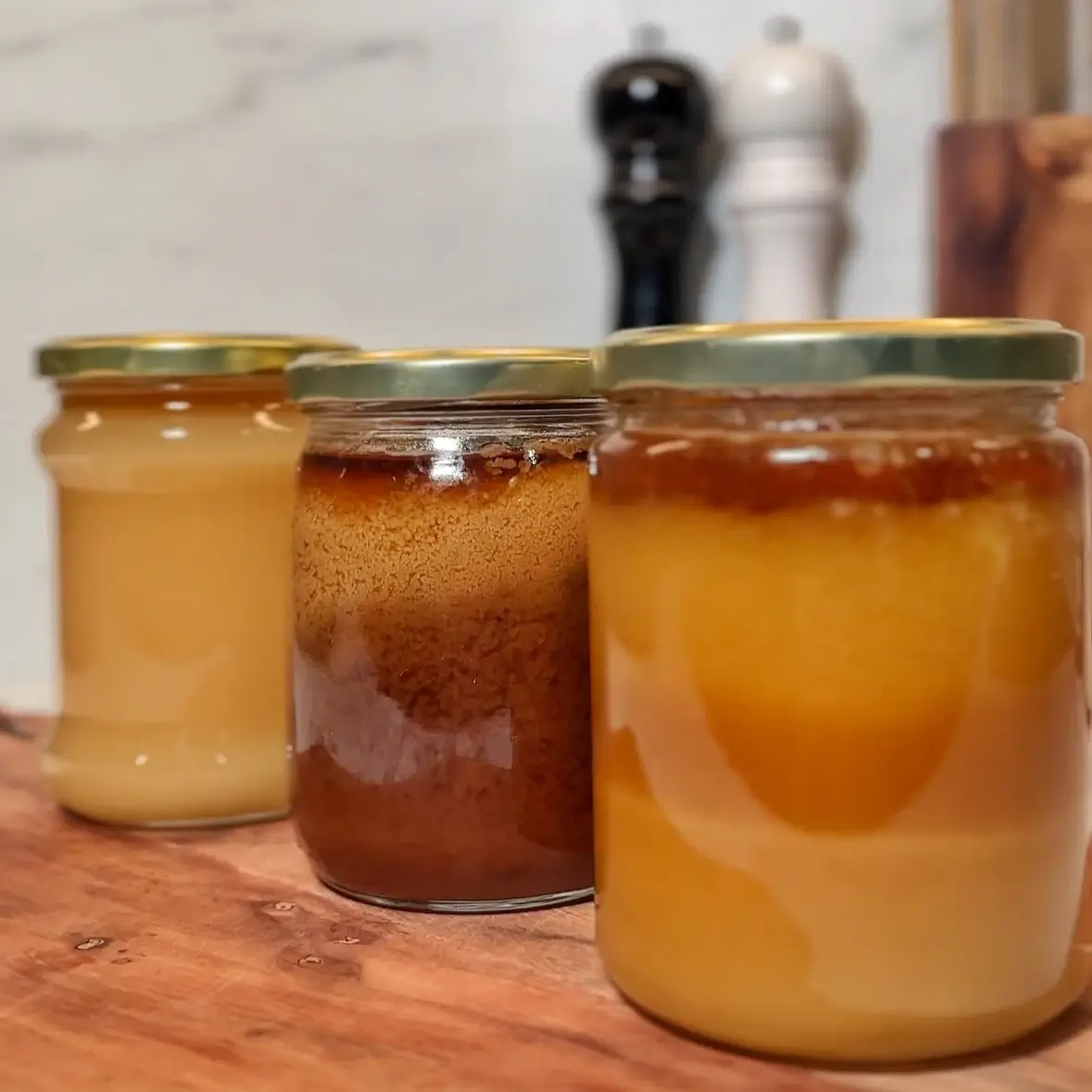
Honey is not only a delicious addition to dishes, but also a valuable source of natural nutrients. However, you may have noticed that sometimes honey can separate, forming two or more layers with different consistencies.
Why does honey separate? You will find the answer to this question in the blog below.
Table of contents:
- Causes of honey separation.
- When to start honey harvesting.
- Chemical composition of honey and temperature conditions.
- Storing honey.
- The crystallization process and honey separation.
- How to restore honey's uniform consistency?
- Summary
1. Causes of honey separation.
The key goal of every beekeeper running an apiary is to produce as much high-quality honey as possible. Sometimes, however, it happens that some batches of honey may separate. The reasons for this phenomenon can be varied - they can arise from the harvesting process, the characteristics of a given species, to the crystallization process and the way it is stored, which is why we will explain this topic in the blog below.
2. When to start honey harvesting?
During honey harvesting, there is a risk of bees bringing in nectar from forage with a higher fructose content. Most often, the process of honey separation occurs in species that border the flowering period of black locust, whose nectar is rich in fructose, and its crystallization time is significantly longer than other honey varieties dominant in Poland which are high-glucose. A similar phenomenon also occurs when honeydew appears, which occurs irregularly and depends on weather conditions.
The question then arises how and when is it best to start honey harvesting?
- It is recommended to harvest honey towards the end of a given forage flow, at the moment when it gradually decreases and weight gains clearly start to diminish for 2 to 3 days. Then the honey will be properly ripe and true to variety.
- Contrary to the common belief of many beekeepers who suggest that honey should be collected when it is available, one should remain patient and not rush too much with the harvest - taking only capped frames will ensure the honey is ripe and stable, and the risk of separation or fermentation will be minimal
- Refractometer testing - in the case of low forage intensity and prolonged drought, all the honey in the hive is usually ripe, even though the combs may not be capped. Combs from honeydew forage are also not always completely capped, but the honey density remains within the norm. Often during abundant forage, there is a risk of obtaining a product that is too thin, which is often harder to crystallize, separates and ferments, so it is worth equipping yourself with a device called a refractometer, which allows you to assess the degree of honey ripeness and readiness for harvesting. Such an investment also limits the risks of separation or fermentation, and thus the occurrence of losses.
3. Chemical composition of honey and temperature conditions.
Ripe honey contains about 80% simple sugars (varying proportions of glucose and fructose depending on the type of honey) and approx. 16-20% water. Honey has hygroscopic properties which means it strongly absorbs moisture, and an excessive water content can lead to unfavourable changes in it, from thinning of the product, through its separation, to the activation of yeasts leading to its fermentation. This phenomenon results from the fact that honey is a supersaturated solution of sugars, and the denser and more mature it is, the more it tends to take in water from the environment, where the humidity level is usually 2-3 times higher than the water contained in it, which is why it is so important to store honey in an airtight container and ensure proper storage conditions.
Unfortunately, many beekeepers leave the honey in partially open settling tanks for a long time after harvesting, allegedly so that excess water can evaporate. It must be emphasised that this is a mistake, because honey concentration occurs exclusively in the hive thanks to the active influence of bees. On the other hand, honey taken from the hive by the beekeeper and left with access to air can, under poor storage conditions, not only become thinned but also lead to the formation of defects in the obtained product. Honey stored in open vessels, even for a short period, can cause its upper layer in contact with air to have even 2 to 4% more water than the rest of the honey, which as we know can lead to separation and fermentation.
When discussing temperature conditions in terms of honey separation the influence of temperature is a significant factor affecting the honey separation process. When the temperature between individual layers of honey is different, it can lead to water migration between them, which in turn results in the product separating. Additionally, variability in the proportions of glucose and fructose can also contribute to intensifying this phenomenon.
Temperature plays a key role in stabilizing the structure of honey. When sudden temperature changes occur, especially when one part of the honey is warmer than the other (e.g. in a sunny spot or a location close to devices that emit heat), it can cause water to move between layers and as a result, areas of different densities are formed, which leads to honey separation.
The chemical composition of honey, in particular the proportions of glucose and fructose, also have a very large impact on its ability to separate. Honeys containing different proportions of these two sugars (depending on their species and variety), can react with water in a different way, which can lead to non-homogeneity in the structure and consistency of the product. Separation most often occurs in species close to the flowering period of black locust and often happens in buckwheat honey due to the fairly equal share of glucose to fructose in this type of honey.
Glucose is a sugar that crystallizes faster - this can best be observed in high-glucose honeys such as rapeseed, which can crystallize even within 1-2 days after extraction. The second sugar that builds honey is fructose, which has a much longer crystallization time - an excellent example here is acacia honey, which in its pure form can crystallize for even more than a year while maintaining ideal temperature conditions (approx. ~14-16 degrees Celsius). At higher temperature conditions, glucose binds faster and settles at the bottom, while the lighter layer of fructose and water is pushed to the top, which is naturally found in ripe honey (approx. 16%).
The described phenomenon of honey separation is therefore natural and results from the physico-chemical properties of honey. We do not need to worry that the honey has some defect that excludes it from consumption, and this is confirmed by the Polish Standard itself PN-88/A-77626 for honey, which describes and permits such a phenomenon.
4. Storing honey.
Another key aspect for the correct course of crystallization is therefore maintaining appropriate storage conditions for honey - it will proceed faster and uniformly if we keep the jars in a dry and cool place (constant temperature approx. 14 degrees Celsius) without access to sunlight. The best place will be a cellar, cool garage or pantry, but if we do not have such rooms and like to have honey always at hand, keeping it in the fridge will also be a good solution. Here, you only need to remember to tighten the jar lid properly, because as we mentioned earlier, honeys are strongly hygroscopic, but they also absorb other smells very well.
Honey belongs to microbiologically stable products that retain their properties provided they are stored correctly. According to the non-obligatory Polish Standard "PN-88/A-77626", honey storage facilities should be dry (relative air humidity 65-75%), clean, sufficiently airy, free from foreign smells, free from pests, protected against insects (bees, wasps, flies, etc.), and the storage temperature should not be higher than 18 ⁰ C. The standard also says that honey is best stored in safe glass packaging, which should be protected from direct sunlight.
5. The crystallization process and honey separation.
The honey crystallization process is a natural phenomenon, which can contribute to its separation. During crystallization, the sugars contained in the honey (mainly glucose and fructose) crystallize, forming crystals of various sizes depending on the species and variety of honey, as well as the prevailing temperature conditions. These crystals settle at the bottom of the vessel, which leads to layer separation.
As the crystallization process progresses, the honey becomes thicker and harder to mix. The result is the possibility of forming layers with different consistencies and compositions. In the case of honey separation, the layer on the surface is usually the previously discussed fructose with a runny honey consistency, while in the lower layer, a layer of already crystallized glucose often settles. The speed of the honey crystallization process depends on many factors, such as the water content in the honey (degree of ripeness), its storage conditions, the time of bottling or the ratio of glucose to fructose content depending on the species and variety of honey. Therefore, different batches of honey will crystallize at different rates and in different ways depending on the above factors, which leads to variations in the structure and consistency of the product.
As a result, when honey crystallizes unevenly, it can lead to its separation. Layers of different densities and consistencies can separate, forming visible lines or areas with a different appearance, the reversal and restoration of which we discuss in the next point.
6. How to restore honey's uniform consistency?
To restore such separated honey, it is enough to gently heat it in a water bath (with a thermometer) or put it in the oven (ideally with electronic temperature control) so that the honey decrystallization process occurs to recombine the ingredients in the honey. The temperature should not exceed 40 degrees Celsius to avoid overheating the honey, as high temperature will destroy its nutritional values, living structure and aroma.
While heating the honey, it is worth stirring it regularly to distribute the heat evenly and prevent it from overheating, and also to speed up this process. Gentle stirring will also help in combining the separated layers of honey, creating a uniform consistency. Once the desired consistency is achieved, leave the honey to cool in a cool, dry and shaded place.
Thanks to this simple process, you can quite quickly restore honey to a uniform consistency and enjoy its unique taste and health benefits without worrying about it separating again if the above recommendations are followed.
7. Summary.
In summary, honey separation can be caused by various factors - from the harvesting process, the characteristics of a given species, to the crystallization process and the way it is stored. By maintaining appropriate storage conditions, honey will reward us with beautiful and uniform crystallization with characteristic frosting, but even if such separation happens to us, it is not a product defect, but a natural phenomenon and results from the physico-chemical properties of honey.
Remember that the consistency of honey - whether it will be liquid, crystallised or even separated - does not affect its taste or nutritional value. These processes are natural and the desired honey consistency can be easily obtained by gentle, skilful handling of temperature.
P.S. Do you prefer knowledge in the form of a short film? Watch our video on why honey separates:
Bibliography
Plewa Jan, Schorzenia Miodu, Wydawnictwo Pasieka24 1/2012
Polish Standard (PN-88/A-77626)